


If you are searching for signs companies near me, the best choice is a local, full-service sign maker that handles design, manufacture and installation under one roof, can show you finished work in your area, and guarantees what it produces. Proximity matters because signs are physical, site-specific products: they need to be measured, fitted and sometimes repaired on your premises. This guide sets out how to compare suppliers, what to ask before you commission anything, and which sign types suit shops, restaurants, bars, vehicles and events across Gauteng, Durban and Cape Town.
What a Local Sign Company Should Actually Offer
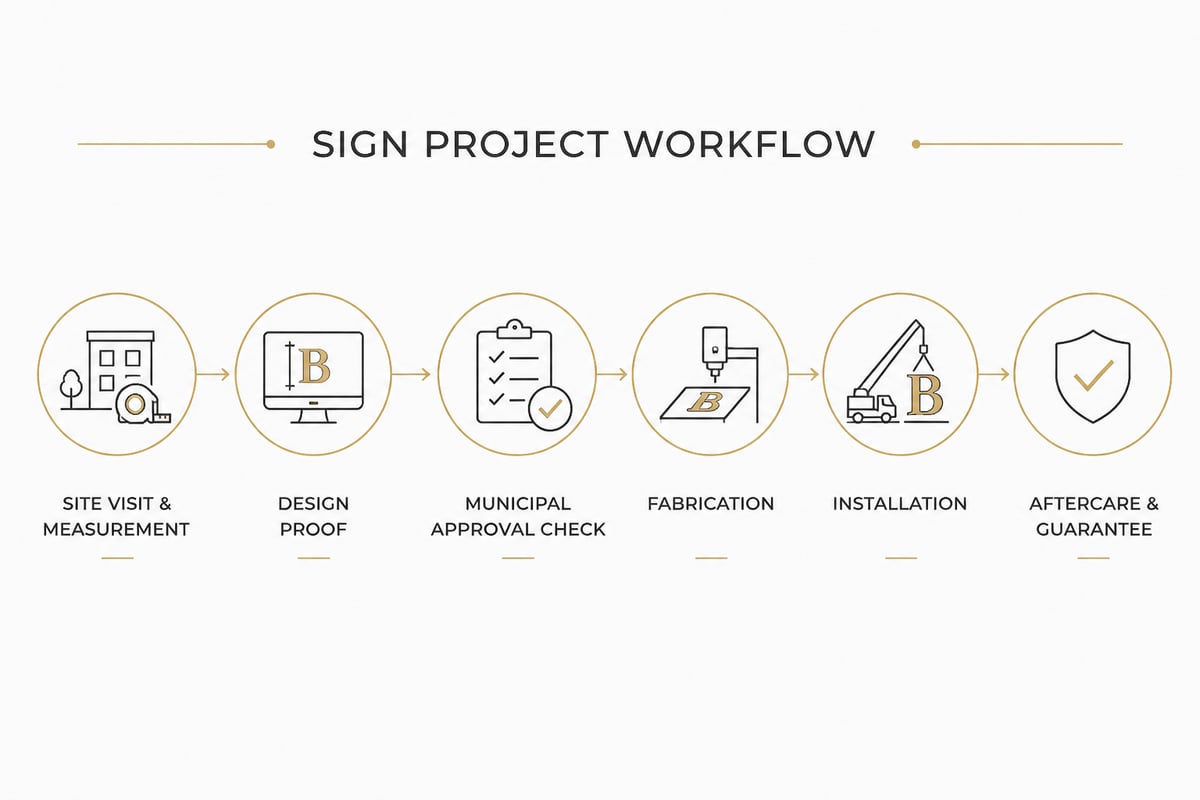
A good local sign company offers a complete service covering design, manufacture, installation and aftercare, so one supplier is accountable for the whole result. Splitting those stages between several suppliers is where delays, mismatched dimensions and finger-pointing tend to start.
Look for these capabilities when you compare suppliers:
- In-house design support, so your logo and brand colours are translated correctly into a sign that can be built
- A broad product range, from door signs and 3D lettering to pylons, banners, vehicle branding and digital signage
- Installation by the same team, ideally with working-at-height experience for facades and monuments
- Material advice, including which finishes survive coastal salt air in Durban and Cape Town or intense highveld sun in Gauteng
- Aftercare and a stated guarantee, so a faulty LED or peeling vinyl is dealt with rather than disputed
Experience is a useful indicator. Signshoponline, for example, advises on materials and production methods whether you need one sign or several hundred, and offers its own design, manufacture and installation services. Those are the kinds of claims worth asking any supplier to substantiate.
Which Type of Sign Does Your Premises Need?
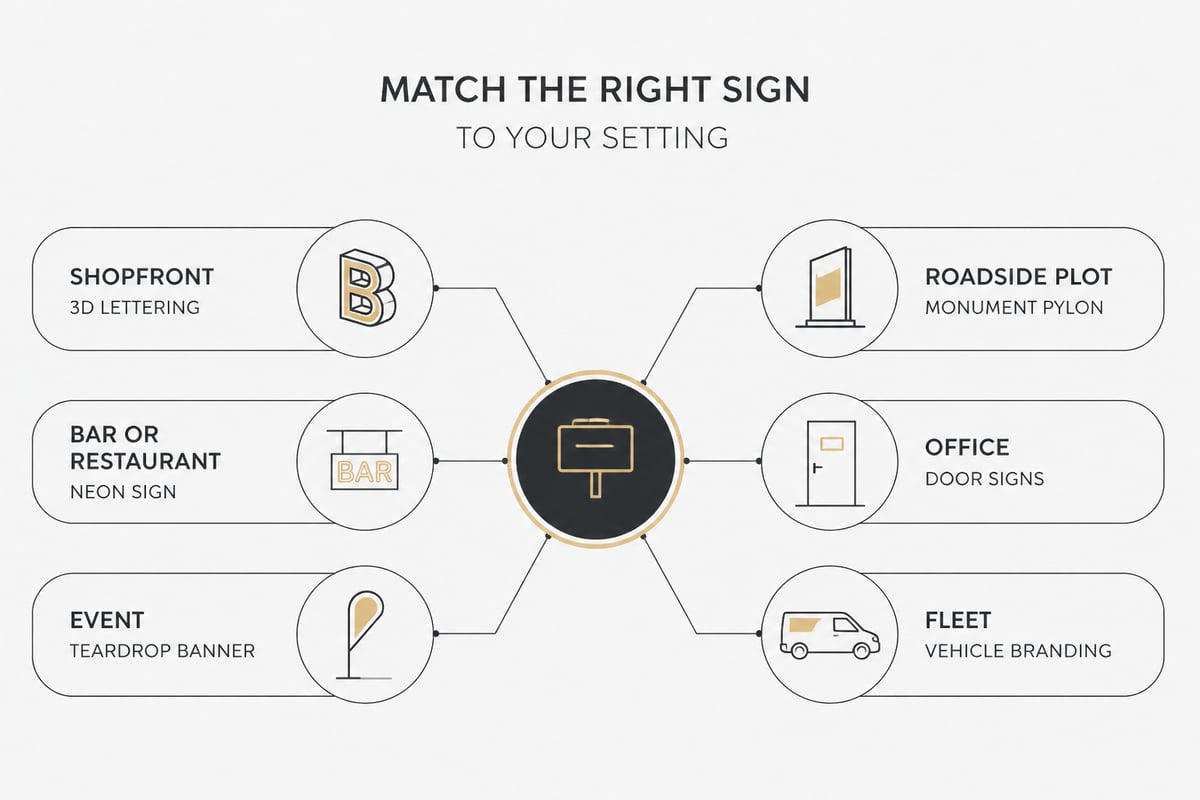
The right sign depends on where it will be seen from, how far away the viewer is and whether it must work at night. Matching the sign type to the setting prevents overspending on the wrong product.
| Situation | Sign type to consider | Why it suits |
|---|---|---|
| Shopfront or office facade | Fabricated 3D lettering, illuminated or non-illuminated | Depth and shadow give a premium, permanent look |
| Roadside business or industrial park | Monument or pylon signs | Visible from a distance and shared by multiple tenants |
| Bars, restaurants and home decor | Neon signs | Warm, distinctive glow that defines an interior |
| Interior offices and suites | Door signs | Clear, consistent wayfinding |
| Warehouses and factories | Industrial signs | Durable, safety-oriented messaging |
| Launches, sales and events | Teardrop banners, large format prints, inflatable billboards | Quick to deploy and easy to change |
| Fleet and delivery vehicles | Vehicle branding | Turns every journey into advertising |
For tenants sharing a plot or park, monument pylons are the usual answer, while warehouses and plants are better served by purpose-built industrial signs. If you are planning a promotion, large format prints can be produced to suit walls, hoardings and event backdrops.
Signs Companies Near Me: A Practical Shortlisting Process
Shortlisting a local sign maker works best as a short sequence of checks, starting with evidence of past work and ending with a written quote you can compare. Following the same steps for each supplier keeps the comparison fair.
- Search by town and product, not just "signs". Phrases such as "neon signs Cape Town" or "3D lettering Johannesburg" surface specialists rather than general printers.
- Review a portfolio of completed installations. Look for work similar in scale and material to yours, ideally photographed on real buildings.
- Confirm they manufacture rather than resell. A company that fabricates in-house controls quality and lead times.
- Ask who installs. Installation by the manufacturer's own team means one point of accountability.
- Request a written quote with a clear scope. It should state materials, finishes, illumination type, installation and any permit support.
- Ask about turnaround and the guarantee in writing. Do not assume standard timelines apply.
Signshoponline's own article on looking for signage companies in South Africa is a useful companion if you are comparing suppliers across several provinces.
Questions to Ask Before You Commit
Asking the right questions up front exposes whether a supplier is genuinely capable or simply well-marketed. The answers should be specific, not vague reassurance.
About materials and durability
Ask what the sign is made from and why. Aluminium, stainless steel, acrylic and vinyl behave very differently in direct sun, rain and coastal air. A supplier who advises on materials according to your location, rather than defaulting to one option, is thinking about the sign's lifespan and not just the invoice.
About illumination and power
For illuminated signs, ask about the type of lighting, how it is powered, and what happens if a section fails. LED lighting is now standard for most channel letters and light boxes because of its efficiency and long service life, but the quality of drivers and wiring varies by manufacturer.
About timing
Lead times differ by sign type. Neon work is a good example, and turnaround can vary by job. Larger fabricated or structural signs often take longer, so ask for dates in writing and confirm what could change them.
About approvals and paperwork
Ask whether the company will help with municipal approvals, site plans and drawings. Even where your own rules differ, the principle is the same: the sign maker should understand what a local authority will ask for.
Permits, Compliance and Why Your Municipality Matters
Most municipalities regulate signs, particularly illuminated, projecting and freestanding ones, so a local sign company that understands approval requirements saves you time and the risk of an order to remove an installed sign. Rules differ widely by location, and the examples below are from other countries to illustrate how detailed they can become. Check your own municipality's by-laws before you commission work.
In New York City, for example, installing a sign with an electrical connection requires a separate work permit, and an illuminated sign extending beyond the building line may require an illuminated-sign permit that is renewed annually. The city's sign-permit overview also explains when licensed sign hangers are required.
San Diego shows a similar pattern. The city requires a sign permit for signs installed or altered on private property, with listed exemptions, and a building permit for ground or monument signs taller than 7 feet. Applications typically involve site plans, sign schedules and elevation drawings, as set out in the city's information bulletin on sign permits.
The lesson for South African businesses is practical. Ask your sign maker what drawings and approvals your municipality is likely to require, particularly for pylons, large facade letters and anything illuminated, and build that time into your launch schedule.
Making Your Sign Readable From the Street
A sign only earns its cost if people can read it in the time they have, so size, contrast and placement should be set by viewing distance. This is where an experienced sign maker adds value beyond simply cutting letters.
The International Sign Association's guidance on sign design and placement gives a clear rule of thumb: allow at least 1 inch of letter height for every 25 feet of viewing distance. Those are US measurements, but the logic converts directly: a roadside plot on a busy arterial needs far larger lettering than a shop in a pedestrian arcade.
A few design principles help in any setting:
- Keep copy short. A name, a descriptor and perhaps one line of detail is usually enough.
- Prioritise contrast. Light lettering on a dark ground, or the reverse, outperforms similar tones.
- Plan for night. If trading continues after dark, illumination is part of the design, not an afterthought.
- Consider accessibility. Where tactile signage is needed, the U.S. Access Board specifies raised characters and Grade 2 braille. Your sign maker can advise on local equivalents.
Illuminated Signs for Venues and Homes
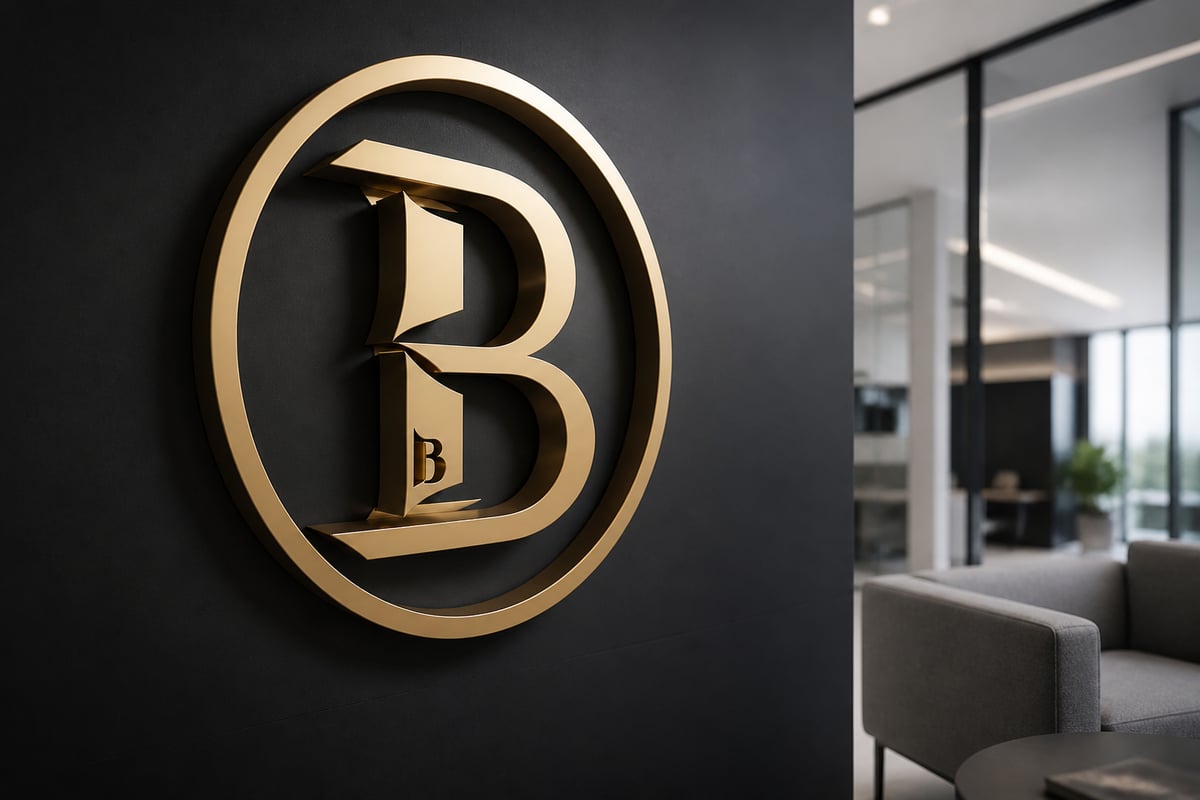
Illuminated signs, particularly neon and 3D channel lettering, give bars, restaurants and design-minded homeowners a focal point that flat printed signs cannot match. They work as both branding and interior decor.
For a facade or a feature wall, dimensional lettering is hard to beat. Signshoponline manufactures fabricated 3D signage, including 3D channel letters in illuminated and non-illuminated versions, which suits businesses wanting a permanent identity above the entrance or behind a reception desk.
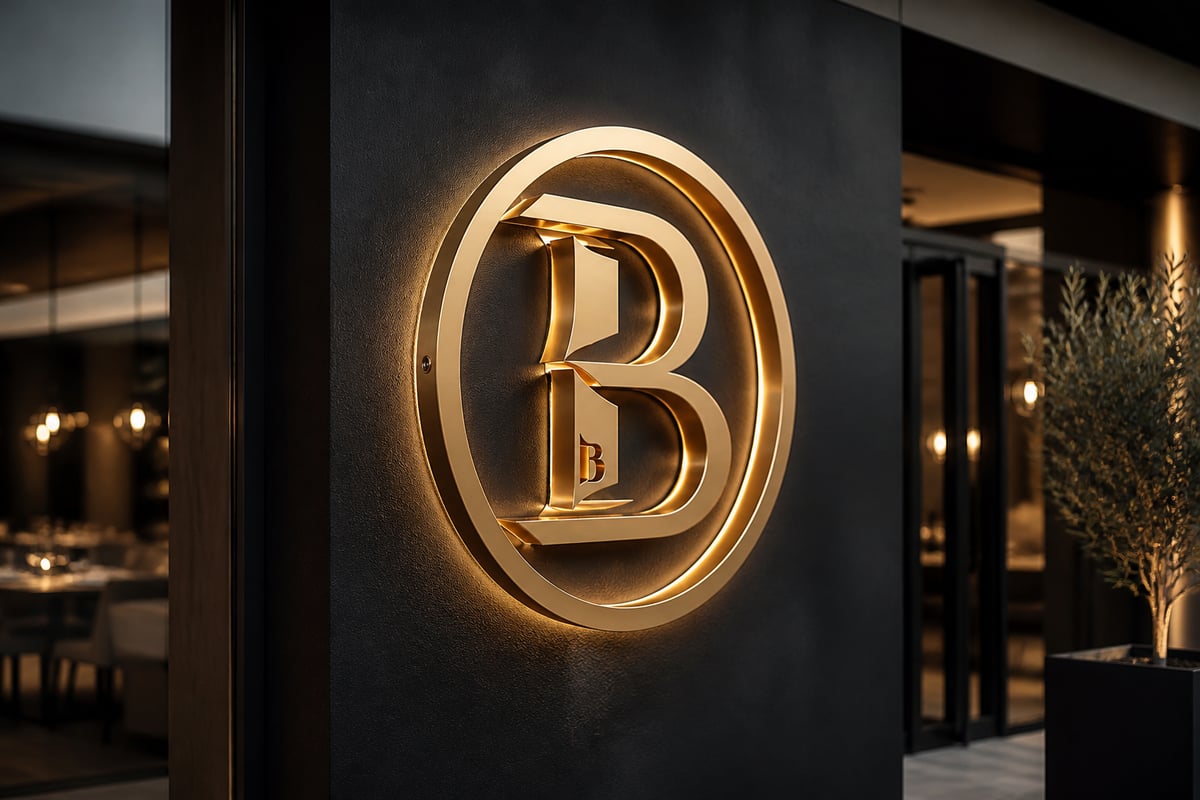
Neon-style signage is the usual choice inside bars and restaurants, and increasingly in homes, where a bespoke piece over a bar, in a games room or behind a bed adds character. Agree the exact wording, colour and size on a proof before production begins, and confirm the delivery and installation arrangements for your area.
Signs for Events, Fleets and Short-Term Promotions
Not every sign is permanent. Banners, inflatables and vehicle graphics suit campaigns, launches and mobile advertising, and a local supplier can turn them around quickly for a specific date.
- Teardrop banners are light, portable and visible from a distance at trade shows, openings and outside showrooms.
- Inflatable billboards create height and impact at large outdoor events.
- Vehicle branding converts delivery vans and company cars into moving advertising that works every day.
- Large format prints cover walls, hoardings and event backdrops.
When you brief a supplier for event work, give the event date, the venue's rules on fixings or anchoring, and where the item will be stored afterwards. Reusable pieces should be specified for durability, while single-use items can be produced more economically.
Related Supplies Worth Planning Alongside Your Signs
A new sign is often one part of a wider fit-out or launch, and coordinating suppliers early prevents last-minute gaps. If you are branding staff clothing or merchandise to match your signage, a custom printer such as Custom 101 Prints shows the kind of apparel and promotional-item services worth sourcing alongside your signs. For a new office or reception area, a furniture supplier such as Pacific Coast Business & Home Office Furniture illustrates the range of workstations and desks to consider so that interior signage and layout are planned together. Always confirm that any supplier you choose operates in or delivers to your region.
Preparing a Brief That Gets Accurate Quotes
A clear brief produces faster, more comparable quotes and fewer revisions. Gather these items before you contact suppliers:
- Your logo in vector format, plus brand colours
- Photographs of the site, with approximate dimensions of the wall, plot or vehicle
- The sign type and whether it should be illuminated
- Your preferred timeline and any fixed dates, such as an opening
- Any landlord, body corporate or municipal restrictions you already know about
- A realistic budget range
Send the same brief to each company so the quotes are directly comparable, and check that each one states what is included: design, manufacture, installation, permits support and guarantee. The cheapest figure is rarely the lowest cost if installation, lighting or aftercare has been left out.
Frequently Asked Questions
How do I know if a sign company is reputable?
Look for a visible portfolio of completed projects, in-house manufacturing, clear written quotes and a stated guarantee. Established experience, such as two decades in the trade, is a positive sign, and any supplier should be willing to explain its materials and processes.
How long does it take to make a sign?
It depends on the type. Signshoponline states that most neon signs are generally turned around in 6 to 8 days, while larger fabricated, structural or pylon signs take longer. Always request a written timeline before you pay a deposit.
Do I need approval before installing a sign?
In most places, yes for illuminated, projecting or freestanding signs, and sometimes for any sign on a facade. Requirements vary by municipality, so ask your local authority and your sign maker what is needed before production starts.
Is it better to choose a local sign maker or order online?
A local or regional supplier can survey the site, install the sign and attend to faults, which matters for facades, pylons and illuminated work. Online ordering can suit simple, portable items, provided you can supply accurate dimensions and artwork.
Start by writing down your sign type, wall or plot dimensions and the date you need it installed, then use that brief to request written quotes. Signshoponline can advise on materials and production methods whether you need one sign or several hundred, including fabricated 3D signage for facades and feature walls. If you are ready to move forward, get a quote from Signshoponline and have your project assessed by its team.


