


Fire extinguisher signs serve a critical role in building safety systems, ensuring that emergency equipment remains visible and accessible when seconds count. These seemingly simple markers are governed by strict regulations, detailed placement requirements, and specific design standards that vary across jurisdictions. Understanding the legal obligations, visibility criteria, and practical implementation of fire extinguisher signs is essential for property managers, facility operators, and business owners who must balance compliance with effective safety communication. In 2026, with evolving accessibility standards and increased emphasis on inclusive design, the specifications for these life-saving indicators continue to develop alongside modern safety practices.
Regulatory Framework for Fire Extinguisher Signs
The legal landscape governing fire extinguisher signs draws from multiple sources, including fire safety codes, accessibility legislation, and workplace safety regulations. In most jurisdictions, the primary authority comes from fire safety standards that mandate both the provision of extinguishers and their clear identification through appropriate signage.
The NFPA 10 Standard for Portable Fire Extinguishers establishes baseline requirements for extinguisher placement and marking in the United States. This standard specifies that extinguishers must be conspicuously located and readily accessible, with signage required when visual obstructions prevent immediate identification. Building codes typically reference NFPA standards as the technical foundation for fire safety compliance.
Key regulatory considerations include:
- Maximum travel distance to extinguishers (typically 23 metres for Class A hazards)
- Mounting height requirements (accessibility within 1.07 to 1.52 metres from floor)
- Sign visibility from normal approach paths
- Colour coding and pictogram standards
- Illumination requirements in low-light conditions
In the United Kingdom, fire safety risk assessment guidance emphasises the importance of clear marking and identification as part of comprehensive premises safety planning. The guidance notes that whilst colour-coded extinguishers provide some visual cue, supplementary signage becomes essential in complex layouts or where multiple fire points exist.
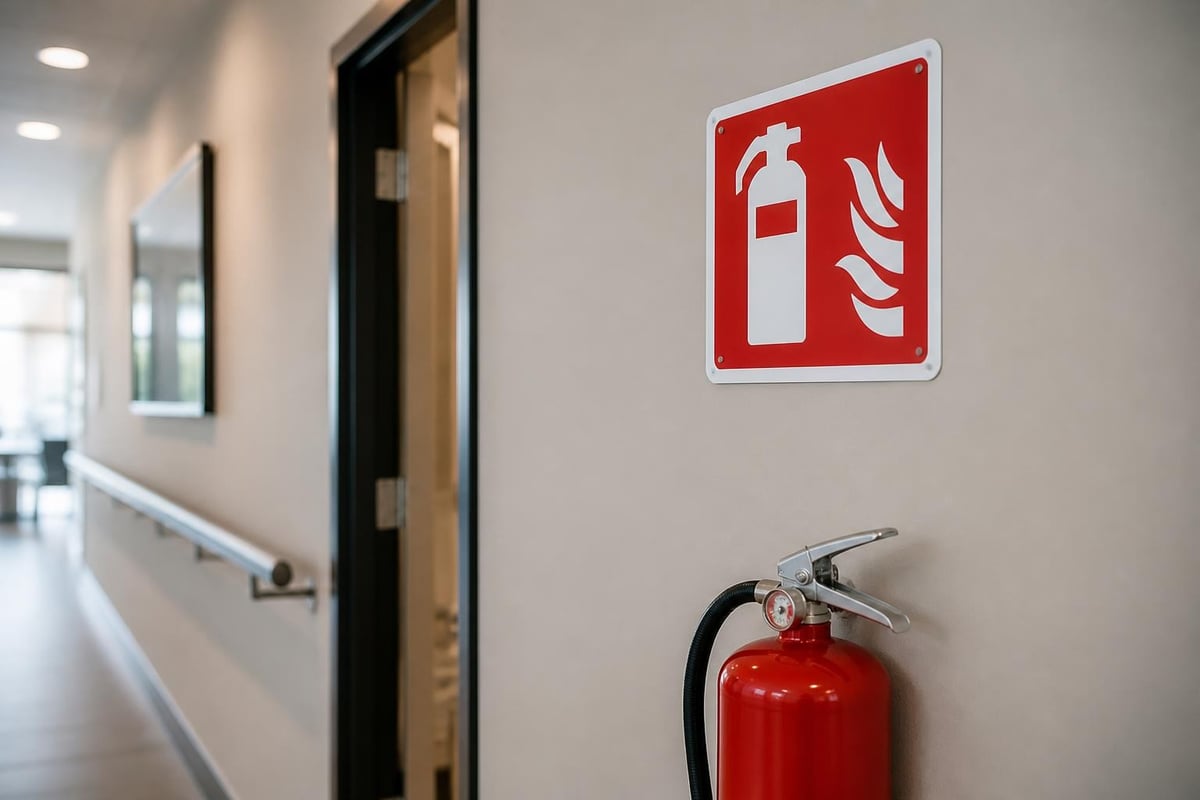
Accessibility and Inclusive Design Standards
Modern fire extinguisher signs must satisfy accessibility requirements that ensure all building occupants can locate emergency equipment regardless of visual ability. The ADA accessibility standards for signs establish specific criteria for visual contrast, character height, and tactile elements where permanent room identification is required.
Whilst fire extinguisher signs typically function as directional rather than permanent room markers, the principles of high contrast, non-glare finishes, and clear typography improve usability for everyone. Contemporary best practice incorporates:
| Design Element | Standard Requirement | Enhanced Accessibility |
|---|---|---|
| Contrast ratio | 70% minimum | 90%+ recommended |
| Character height | 16mm minimum at 2m viewing distance | Proportional scaling for actual viewing distance |
| Pictograms | ISO 7010 compliant symbols | Symbol + text combination |
| Finish | Matt or semi-matt | Anti-glare materials |
Design Specifications and Visual Standards
Fire extinguisher signs must communicate instantly and unambiguously, often in stressful emergency conditions when cognitive function may be impaired. The design specifications that govern these signs reflect decades of research into visual perception, colour psychology, and emergency response behaviour.
Colour Coding and Symbolisation
International standardisation has converged on red as the primary colour for firefighting equipment identification. ISO 7010, the global standard for safety symbols, designates red circular backgrounds with white pictograms for mandatory fire safety actions and equipment locations.
The standard fire extinguisher sign typically features:
- Red background panel (Pantone 485C or RAL 3001) occupying at least 50% of sign area
- White pictogram showing extinguisher profile or flame symbol
- Directional arrow (when indicating location rather than marking equipment position)
- Supplementary text identifying extinguisher type or instructions
Some jurisdictions require additional information layers. The HSE guidance on safety signs recommends including extinguisher classification information where multiple types serve different fire risks within a single facility.
Size and Visibility Requirements
Sign dimensions must ensure visibility from the maximum approach distance expected in the space. The relationship between viewing distance and minimum sign size follows established formulae that account for human visual acuity and environmental factors.
General sizing guidelines:
- Calculate maximum viewing distance in the space
- Apply ratio of 1:100 (sign height in mm = viewing distance in metres)
- Adjust upward for poor lighting, visual clutter, or oblique viewing angles
- Verify minimum character height meets local code requirements
For example, in a corridor where the maximum viewing distance is 15 metres, the minimum sign height should be 150mm. However, if that corridor has multiple doorways, equipment, and visual distractions, increasing to 200-250mm provides a safety margin.
Photoluminescent materials offer an alternative to electrical illumination, absorbing ambient light and glowing in darkness. These materials must meet specific luminance decay rates, typically maintaining at least 25 milicandelas per square metre after 10 minutes in darkness and 2 mcd/m² after 60 minutes.
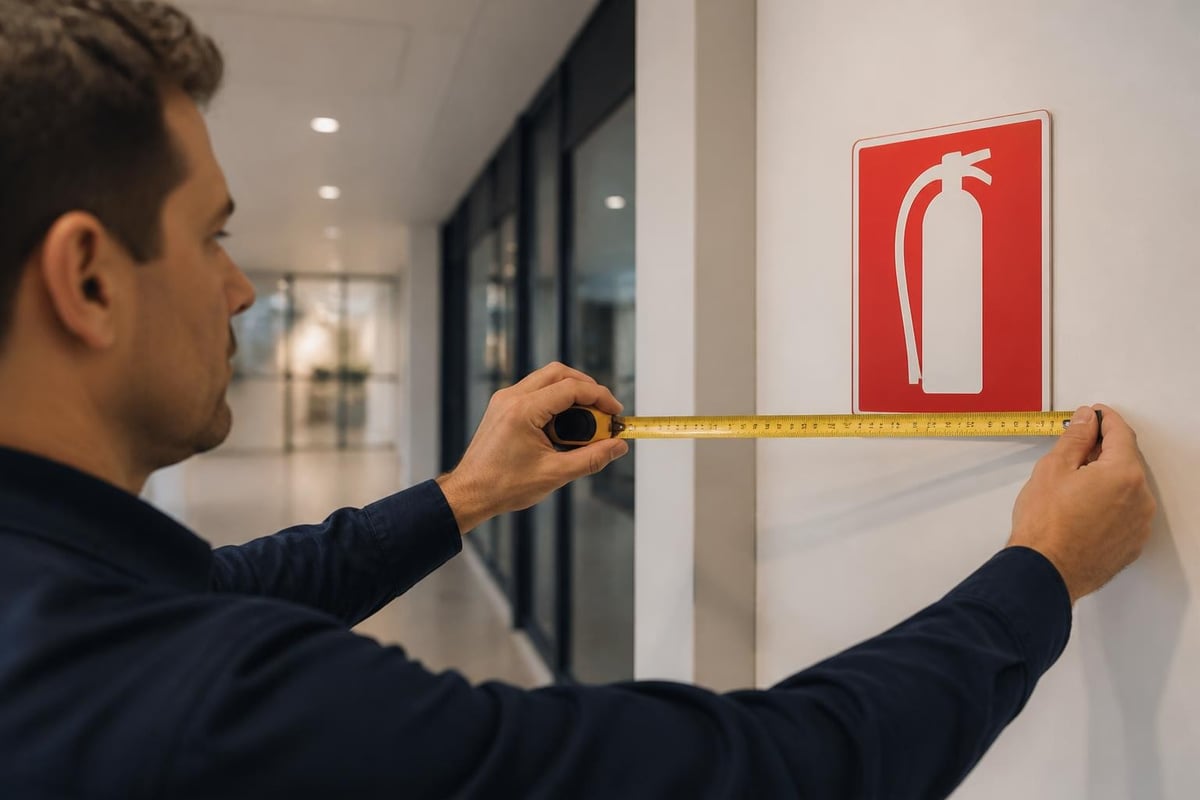
Placement Strategy and Installation Best Practices
Strategic placement of fire extinguisher signs requires understanding traffic patterns, sightlines, and human behaviour during emergencies. Simply mounting a sign directly above an extinguisher may prove insufficient if structural elements, furniture, or normal business operations obscure the view from likely approach directions.
Location Assessment Methodology
Conduct a comprehensive placement assessment by walking typical routes through the facility and identifying potential visual obstructions. Consider perspectives from various heights, accounting for wheelchair users, children, and standing adults. Document blind spots created by:
- Structural columns and wall projections
- Storage equipment and shelving
- Suspended ceiling elements and lighting fixtures
- Temporary displays and seasonal decorations
- Doorways in open position
Where direct line-of-sight cannot be maintained, implement a wayfinding strategy using directional signs at decision points. A person navigating to an extinguisher should encounter clear directional information at each junction or turning point.
Effective placement hierarchy:
- Primary sign mounted directly above or adjacent to extinguisher
- Corridor signs visible from both approach directions
- Junction signs at intersections directing to nearest extinguisher
- Ceiling-mounted signs in open-plan areas with variable furniture layouts
Mounting Height and Orientation
Standard mounting height places the bottom edge of the sign at approximately 2 metres above finished floor level, ensuring visibility over typical obstructions whilst remaining within normal viewing range. This elevation also protects signs from accidental damage during normal operations.
Consider adjusting mounting height in specific circumstances:
- Higher ceilings: Increase height proportionally but maintain visibility
- Low ceilings: May mount lower but ensure clearance above extinguisher
- Projecting signs: Perpendicular wall-mounted flags visible from multiple directions
- Suspended signs: Ceiling-hung signs in large open spaces
The sign must orient perpendicular to the primary direction of approach. In corridors, this typically means facing along the corridor axis. In rooms, orient toward the most common entry point. Where multiple approach directions exist, specify multi-faced or projecting sign configurations.
Many businesses benefit from professional signage suppliers who understand the interplay between regulatory compliance and practical visibility. Signshoponline offers expertise in safety signage that meets both legal requirements and real-world functionality needs.
Material Selection and Durability Considerations
Fire extinguisher signs must withstand environmental conditions for years without degradation in visibility or structural integrity. Material selection balances initial cost against lifecycle performance, considering factors such as cleaning protocols, UV exposure, humidity, and mechanical stress.
Common Material Options
| Material | Advantages | Limitations | Typical Lifespan |
|---|---|---|---|
| Rigid PVC | Economical, lightweight, weather-resistant | Can warp in extreme heat | 5-7 years outdoors |
| Aluminium composite | Excellent durability, professional appearance | Higher cost, requires proper fixings | 10+ years |
| Acrylic | High clarity, weather-proof, modern aesthetic | Prone to scratching, may yellow over time | 7-10 years |
| Photoluminescent vinyl | Self-illuminating, no power required | Requires light charging, performance degrades | 5-8 years |
Outdoor installations demand materials rated for UV resistance and temperature cycling. Marine-grade aluminium or UV-stabilised polymers prevent the fading and brittleness that compromise standard materials in harsh sunlight. Coastal environments require additional consideration for salt-air corrosion.
Surface Treatments and Finishes
Surface finish significantly impacts long-term performance. Matt or satin finishes reduce glare that can obscure symbols under bright lighting or when viewed at acute angles. However, these finishes may show dirt more readily than gloss surfaces in industrial environments.
Anti-graffiti laminates protect signs in public-access areas, allowing spray paint and marker removal without damaging underlying graphics. This protection extends sign life considerably in vandalism-prone locations whilst maintaining professional appearance.
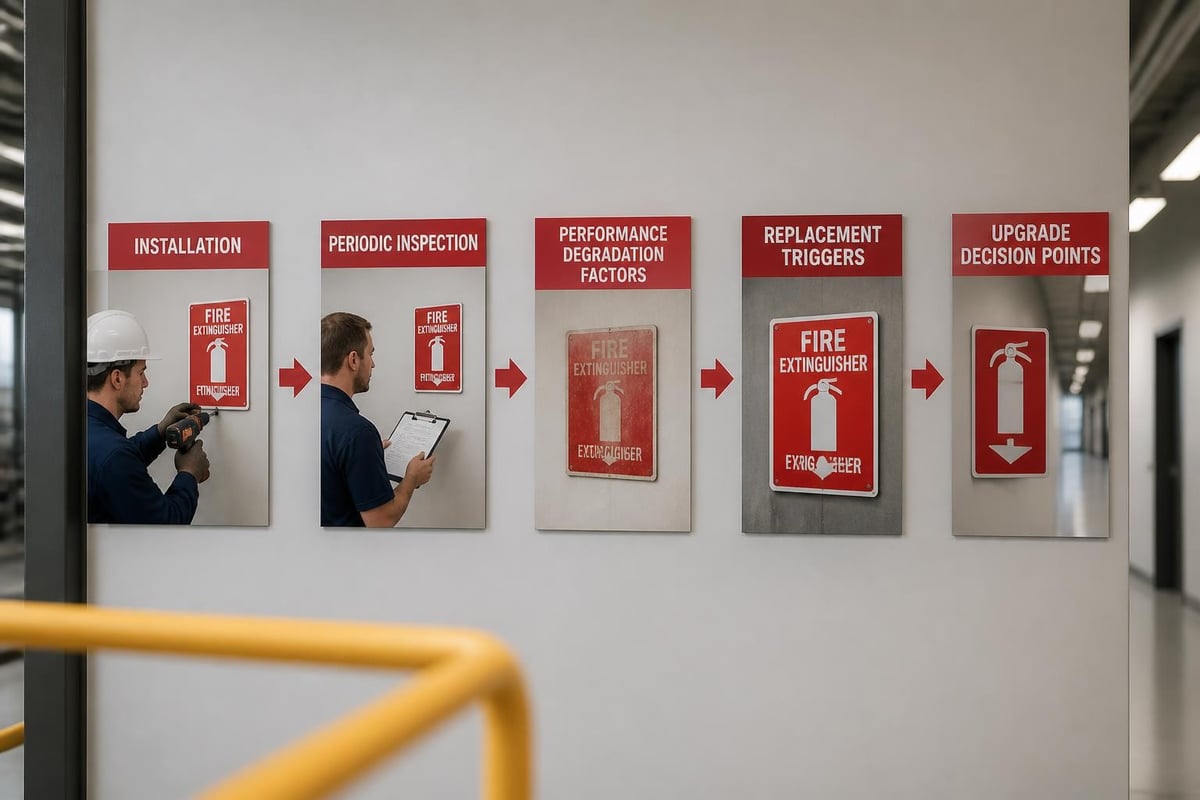
Maintenance Programmes and Periodic Verification
Fire extinguisher signs require ongoing attention to maintain compliance and effectiveness. Fading, damage, dirt accumulation, and changes to facility layout can all compromise sign performance between initial installation and the next inspection cycle.
Inspection Schedules
Establish a regular inspection protocol that coordinates with general fire safety equipment checks. Monthly visual inspections verify that signs remain in place, clearly visible, and free from obstruction. Annual detailed inspections assess material condition, legibility, and alignment with current facility configuration.
Inspection checklist elements:
- Physical integrity (no cracks, bends, or missing components)
- Graphics clarity (no fading, discolouration, or peeling)
- Mounting security (fixings tight, no rotation or sagging)
- Visibility from approach paths (no new obstructions)
- Photoluminescent charge retention (where applicable)
- Alignment with current extinguisher locations
Document inspection findings and remediation actions. This record demonstrates due diligence during compliance audits and insurance reviews. Many jurisdictions require maintenance logs as evidence of ongoing fire safety management.
Replacement Triggers and Upgrade Opportunities
Replace fire extinguisher signs when any of the following conditions occur:
- Graphics have faded to less than 70% original intensity
- Physical damage compromises structural integrity or visibility
- Facility modifications have relocated extinguishers
- Updated standards require different symbols or information content
- Photoluminescent materials fail performance testing
Facility renovations and reconfigurations present opportunities to upgrade signs to current best practices even when existing signs technically remain compliant. Consider incorporating improved materials, enhanced visibility specifications, or modern design standards that exceed minimum requirements.
Special Considerations for Different Building Types
Different facility types present unique challenges for fire extinguisher sign implementation. The optimal approach for a warehouse differs substantially from requirements in a healthcare facility, educational institution, or heritage building.
Industrial and Warehouse Environments
Large open spaces with high ceilings demand oversized signs visible from considerable distances. Suspended signs or wall-mounted units with extended brackets project into sightlines. Standardised mounting heights may require adjustment to account for racking systems, machinery, and vehicle traffic.
Consider illuminated or photoluminescent options in areas where lighting may fail during emergencies or where 24-hour operations create variable lighting conditions. Industrial environments also benefit from protected sign installations that resist impact from mobile equipment and materials handling.
Healthcare and Educational Facilities
These environments serve populations with varying capabilities, requiring enhanced accessibility features. Multilingual text may be appropriate where diverse populations regularly use the facility. Tactile elements, whilst not typically mandated for directional fire safety signs, can improve usability for vision-impaired occupants.
Coordinate sign placement with infection control protocols, ensuring cleaning procedures can access all surfaces without creating temporary visual obstructions. In paediatric areas, consider supplementary lower-height signs that remain visible to children whilst maintaining standard adult-height installations.
Retail and Hospitality Settings
Customer-facing environments balance safety compliance with aesthetic integration. Fire extinguisher signs must remain clearly visible whilst not detracting from designed ambiences. Discreet mounting, refined typography, and materials that harmonise with interior finishes achieve this balance without compromising safety function.
Back-of-house areas, storage rooms, and service corridors may utilise standard industrial specifications. However, public spaces benefit from refined designs that maintain regulatory compliance whilst integrating into the overall design language. Professional signage specialists can develop custom solutions that satisfy both requirements.
Integration with Comprehensive Fire Safety Systems
Fire extinguisher signs form one component within broader fire safety communication frameworks. Effective integration with emergency lighting, evacuation signage, fire alarm systems, and building management protocols creates layered redundancy that enhances overall life safety performance.
Coordinated Visual Communication
Develop a unified visual language across all fire safety elements. Consistent colour coding, typography, and symbol usage reduce cognitive load during emergencies when occupants must rapidly process multiple information sources. This coordination extends to:
- Fire exit and evacuation route signs
- Assembly point markers
- Fire alarm call point identification
- Emergency lighting indicators
- Parking and traffic signs directing emergency vehicle access
Standardisation across multiple facilities within an organisation provides additional benefits. Personnel familiar with one location can more readily navigate others within the same portfolio, particularly valuable for mobile workers or visiting contractors who may need to respond to emergencies in unfamiliar buildings.
Digital Integration and Smart Building Systems
Advanced building management systems increasingly incorporate fire safety equipment into comprehensive monitoring frameworks. Digital signage can supplement traditional static signs by displaying dynamic information about extinguisher locations, providing visual guidance during emergencies, or highlighting the nearest equipment based on detected fire locations.
However, digital systems must serve as enhancements rather than replacements for traditional signs. Power failures, system malfunctions, and networking issues can compromise digital displays precisely when they're most needed. Static, passive fire extinguisher signs provide essential redundancy that functions independently of building systems.
Implementing compliant, effective fire extinguisher signs requires balancing regulatory requirements with practical visibility needs across diverse building types and use cases. By understanding the specifications that govern these critical safety markers and developing comprehensive placement strategies, facility managers create environments where emergency equipment remains instantly accessible when needed. Whether you're upgrading existing installations or planning signage for new construction, Signshoponline delivers professional safety signage solutions backed by expertise in regulatory compliance and proven manufacturing quality.


