


Vehicle branding transforms ordinary cars, vans, and lorries into mobile marketing platforms that reach thousands of potential customers daily. Every journey becomes a branding opportunity, whether your fleet navigates busy motorways, parks in high-footfall retail areas, or delivers goods door-to-door across multiple postcodes. A well-executed branding car strategy amplifies your visual presence far beyond fixed signage, offering one of the most cost-effective advertising methods available in 2026. From partial decals to full wraps, businesses increasingly recognise that their vehicles represent untapped marketing real estate capable of generating hundreds of thousands of impressions each month without ongoing media costs.
Why Vehicle Branding Delivers Exceptional Marketing ROI
Business vehicles travel an average of 15,000 to 25,000 miles annually, exposing your brand to diverse audiences across urban centres, industrial estates, and residential neighbourhoods. Unlike static billboards that remain fixed in a single location, a branding car solution moves through different demographics throughout the working day.
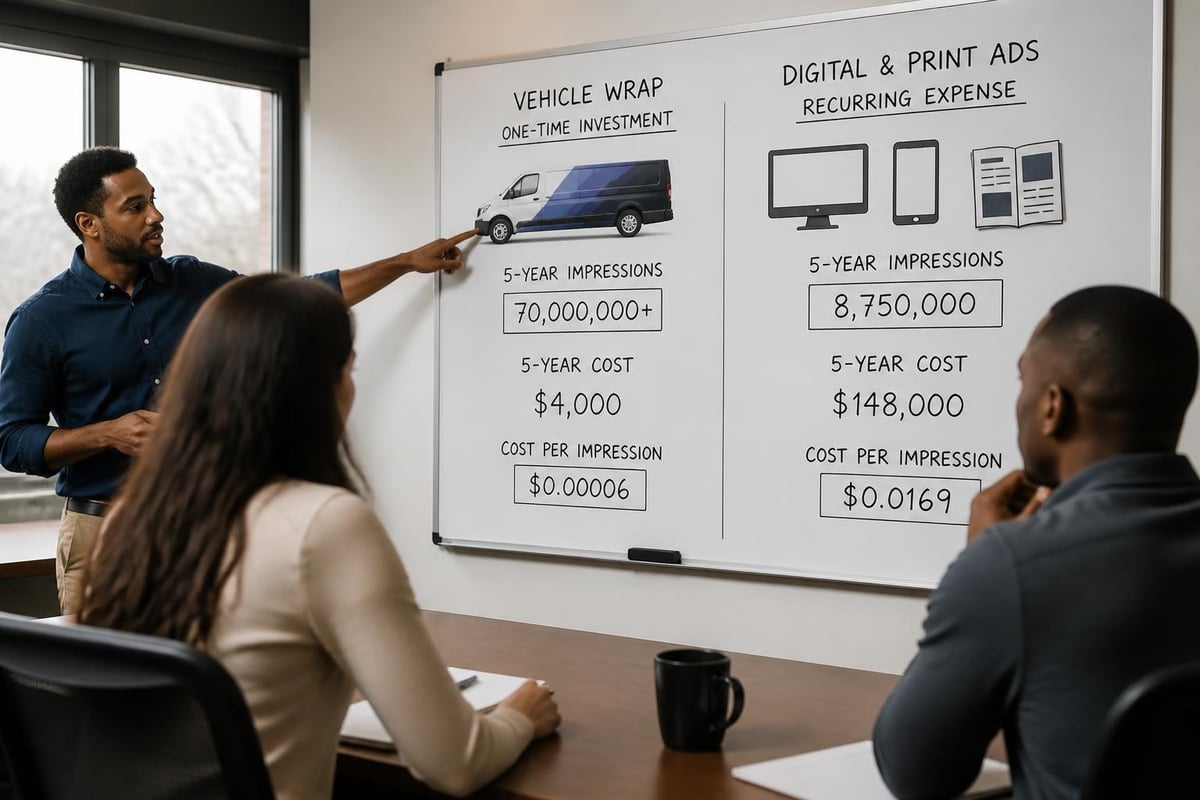
The Out-of-Home advertising sector demonstrates strong ROI, particularly for mobile advertising where metrics show measurable lifts in brand awareness and purchase intent. Vehicle branding provides continuous exposure with a one-time investment, unlike digital advertising that requires ongoing budget allocation.
Cost Comparison: Vehicle Branding vs. Traditional Advertising
| Advertising Medium | Annual Cost (Est.) | Impressions/Year | Cost per 1,000 Impressions |
|---|---|---|---|
| Vehicle Wrap | £2,500–4,500 | 600,000+ | £4.17–7.50 |
| Billboard (Prime) | £12,000–36,000 | 250,000–400,000 | £30.00–144.00 |
| Radio Campaign | £15,000–50,000 | Varies | £50.00+ |
| Digital Display Ads | £8,000–25,000 | 500,000+ | £16.00–50.00 |
The numbers clearly favour vehicle branding as a long-term investment. A quality wrap lasts five to seven years with proper maintenance, spreading that initial cost across multiple years whilst generating consistent visibility.
Essential Elements of Effective Branding Car Design
Successful vehicle branding balances visual impact with legibility. Your design must communicate key messages to audiences who encounter your vehicle briefly in traffic or whilst parked.
Typography and readability form the foundation of effective vehicle graphics. Research on sign design and legibility emphasises that letterforms need sufficient height, spacing, and contrast to remain readable at distance and speed. Business names should use sans-serif typefaces at minimum 3-inch heights for visibility beyond 30 feet.
Colour psychology influences how audiences perceive your brand. Studies exploring colour and sentiment in marketing contexts reveal that colour choices trigger emotional responses that affect brand recall. Bold, high-contrast combinations ensure visibility across weather conditions and times of day.
Key Design Principles for Mobile Branding
- Prioritise hierarchy: Place your company name and logo most prominently
- Limit text: Include only essential information (name, website, telephone, tagline)
- Consider viewing angles: Design wraps accounting for how vehicles appear from front, side, and rear
- Maintain brand consistency: Use established brand colours, fonts, and visual elements
- Test legibility: Review designs at reduced sizes to simulate distance viewing
The visual principles for driving contexts remind designers that text must compete with complex visual environments. High contrast ratios (minimum 4.5:1 for standard text, 3:1 for large graphics) ensure your branding car remains visible against varied backgrounds.
Types of Vehicle Branding Solutions
Different branding car approaches suit varying budgets, brand requirements, and vehicle types. Understanding these options helps businesses select solutions aligned with their marketing objectives.
Full Vehicle Wraps
Complete wraps cover every painted surface, transforming vehicles into moving brand statements. These solutions offer maximum visual impact and protect underlying paintwork from UV damage and minor abrasions.
- Design flexibility: No restrictions on graphics, allowing creative freedom
- Complete transformation: Entirely changes vehicle appearance
- Premium positioning: Signals professional, established business status
- Paint protection: Preserves resale value by protecting original finish
Partial Wraps and Decals
Partial solutions cover selected panels or apply vinyl graphics to specific areas whilst leaving original paint visible. This approach balances cost-effectiveness with professional appearance.
Budget-conscious businesses often choose partial wraps covering doors and rear panels where visibility proves highest. Strategic placement ensures branding remains prominent without full-wrap investment.
Magnetic Signage
Removable magnetic panels suit businesses using personal vehicles for work or requiring flexibility to remove branding. These solutions work best on flat metal surfaces and smaller format requirements.
Advantages: Removable, transferable between vehicles, lower initial cost
Limitations: Restricted to magnetic-compatible surfaces, smaller sizes, potential for theft or loss
Window Graphics and Perforated Film
Perforated vinyl films applied to rear windows and glass surfaces maintain driver visibility whilst displaying brand messages externally. One-way vision technology allows occupants to see out clearly whilst presenting solid graphics to outside viewers.
Legal and Compliance Considerations for Branding Car Projects
Vehicle branding must comply with road traffic regulations, visibility requirements, and intellectual property laws. Understanding these parameters prevents costly errors and potential legal complications.
Driver visibility remains paramount. Regulations prohibit graphics that obstruct driver sightlines through windscreens or required mirror views. Side and rear windows may accommodate perforated films, but front windscreens maintain strict limitations except for small manufacturer/tax disc areas.
The Manual on Uniform Traffic Control Devices establishes standards ensuring vehicle graphics don't mimic official traffic control devices or emergency vehicle markings. Whilst primarily applicable to US contexts, these principles inform international best practice regarding colour combinations and patterns that might confuse other road users.
Intellectual Property and Trademark Concerns
Businesses using third-party logos, brand names, or personality imagery must secure appropriate permissions. Legal frameworks governing trademark and identity rights establish that unauthorised use may constitute infringement, regardless of whether the vehicle branding serves commercial purposes.
Authorised dealers and franchise operators typically receive brand guideline documents specifying exact logo placement, colour specifications, and co-branding requirements. Adhering to these standards maintains brand integrity and contractual compliance.
Professional Installation vs. DIY Application
Whilst DIY vinyl application seems cost-effective initially, professional installation delivers superior results, longevity, and finish quality that justify the investment for most businesses.
Professional installers bring specialised tools, climate-controlled environments, and experience managing complex curves, seams, and panel transitions. They understand material behaviour, appropriate surface preparation, and techniques preventing air bubbles, wrinkles, or premature edge lifting.
Amateur applications frequently encounter:
- Air bubbles and wrinkles requiring rework
- Improper surface preparation causing adhesion failure
- Incorrect material selection for specific surfaces
- Poor seam placement creating visual inconsistencies
- Inadequate edge sealing leading to premature peeling
Installation Timeline and Vehicle Downtime
| Vehicle Type | Full Wrap Duration | Partial Wrap Duration | Complexity Factors |
|---|---|---|---|
| Small Car | 2–3 days | 1 day | Minimal curves, simple panels |
| Large Van | 3–5 days | 1–2 days | Complex curves, multiple panels |
| Box Lorry | 3–4 days | 1–2 days | Large flat surfaces, height access |
| Specialist Vehicle | 4–7 days | 2–3 days | Custom bodywork, complex geometry |
Schedule installations during slower business periods to minimise operational disruption. Many installers offer collection and delivery services, reducing logistical complexity for busy fleets.
Material Selection and Durability Factors
Vinyl quality directly impacts branding car longevity, appearance retention, and removal characteristics. Premium materials justify higher initial costs through extended service life and superior performance.
Cast vinyl films conform to complex curves and recesses whilst maintaining dimensional stability across temperature extremes. These materials typically last five to seven years before showing significant fading or degradation.
Calendared vinyl suits flatter surfaces and shorter-term applications. Less expensive than cast alternatives, calendared films work well for promotional campaigns or applications expected to change within two to three years.
Environmental Considerations and Material Performance
UV exposure, temperature fluctuations, and environmental pollutants affect vinyl longevity. Vehicles parked outdoors continuously experience faster degradation than garaged fleets. Quality laminates protect printed graphics from UV damage, chemical exposure, and abrasion.
Consider these durability factors:
- Climate: Intense sun accelerates fading; extreme cold may affect adhesion
- Cleaning frequency: Regular washing extends life but requires appropriate methods
- Storage: Covered parking significantly extends wrap lifespan
- Usage patterns: High-mileage vehicles experience more stone chips and environmental exposure
Maintenance and Care for Branded Vehicles
Proper maintenance preserves branding car appearance and extends wrap lifespan. Establishing care protocols across fleets ensures consistent brand presentation.
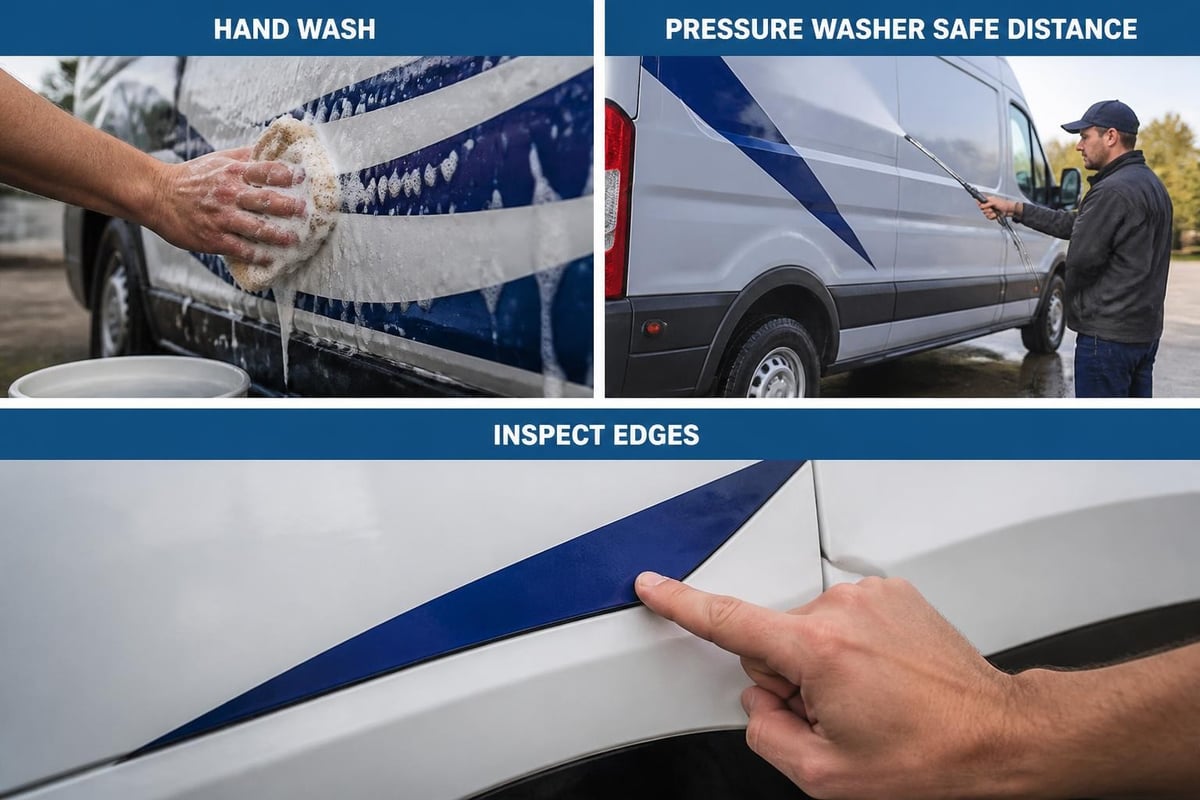
Washing techniques require gentler approaches than standard paintwork. Hand washing with pH-neutral soaps protects vinyl surfaces better than automated brush car washes that may catch wrap edges or cause lifting. Pressure washers used carefully (maintaining 40+ cm distance, avoiding direct edge spray) provide effective cleaning without damage.
Common Maintenance Challenges and Solutions
| Issue | Cause | Prevention | Solution |
|---|---|---|---|
| Edge lifting | Poor initial installation or pressure wash damage | Quality installation, careful washing | Re-heat and re-apply affected edges |
| Fading | UV exposure without adequate laminate | Use UV-protective laminates | Replace affected panels |
| Scratches | Abrasion from branches, tight spaces | Careful driving, protective laminate | Minor: heat treatment; Major: panel replacement |
| Adhesive residue | Improper removal technique | Professional removal only | Heat application and adhesive remover |
Regular inspections identify minor issues before they escalate. Addressing small lifting edges immediately prevents moisture infiltration that compromises larger sections.
Measuring the Impact of Your Branding Car Strategy
Quantifying vehicle branding effectiveness helps justify investment and refine approach. Unlike digital marketing's precise analytics, measuring mobile advertising requires creative tracking methodologies.
Website traffic analysis reveals whether branded vehicles drive online enquiries. Unique telephone numbers or web addresses specific to vehicle graphics track inbound contacts generated by mobile visibility. URL shorteners with tracking capabilities measure how many people type vehicle-displayed web addresses.
Tracking Methods for Vehicle Branding ROI
- Unique promotional codes: Vehicle-specific discount codes track conversion
- Dedicated phone numbers: Call tracking attributes enquiries to vehicle exposure
- Customer surveys: "How did you hear about us?" captures vehicle mentions
- Geographic analysis: Increased enquiries from fleet operating areas suggest vehicle impact
- Social media monitoring: Track hashtags or mentions related to vehicle sightings
Geographic heat mapping of customer locations identifies whether enquiry patterns correlate with regular vehicle routes. Clusters around frequent stops or delivery areas suggest effective branding car impact.
The research on variable message sign legibility demonstrates that viewers retain messages differently based on exposure duration and frequency. Repeated sightings of branded vehicles strengthen recall and familiarity, building subconscious brand association even when viewers don't actively engage immediately.
Strategic Fleet Branding Considerations
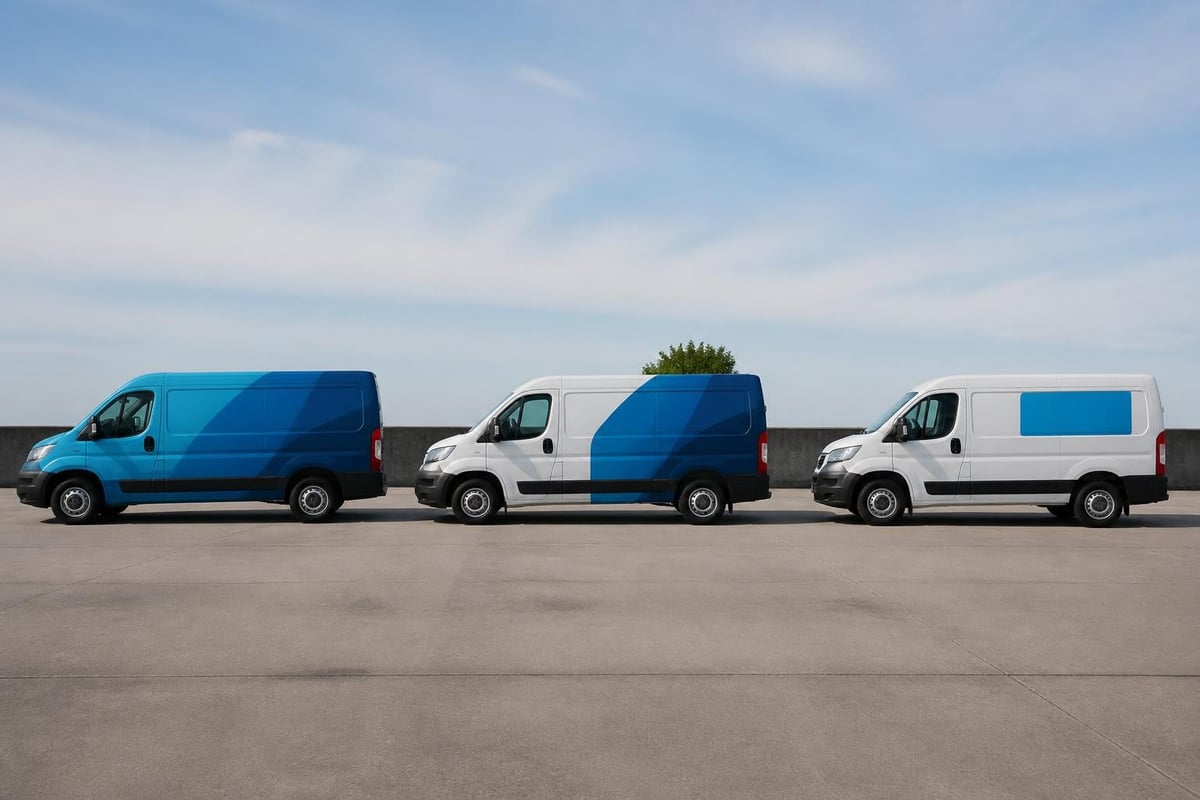
Businesses operating multiple vehicles amplify branding impact through coordinated fleet graphics. Consistent design across your fleet creates professional cohesion whilst allowing variations for different vehicle types or service categories.
Uniformity signals scale and reliability. Customers encountering multiple branded vehicles throughout their daily routines perceive established, successful operations. This repeated exposure builds trust and top-of-mind awareness when service needs arise.
Consider staggered wrap schedules to distribute costs and maintain fresh appearance across the fleet. Rather than wrapping all vehicles simultaneously, phase installations across quarters whilst ensuring minimum viable branding presence.
Variations Within Consistent Branding Systems
Maintain core elements (logo, colour scheme, typography) whilst adapting layouts for different vehicle types:
- Small cars: Simplified designs focusing on logo and website
- Vans: More detailed information including services list
- Lorries: Large-format graphics maximising visibility at distance
- Specialist vehicles: Service-specific messaging (e.g., "Emergency Plumbing" on call-out vans)
This approach maintains brand recognition whilst optimising message relevance for each vehicle's function and audience exposure patterns.
Integrating Vehicle Branding with Broader Marketing Strategy
Branding car solutions deliver maximum impact when integrated with comprehensive marketing ecosystems. Your mobile branding should reinforce messages across digital platforms, physical locations, and other advertising channels.
Visual consistency across touchpoints strengthens brand recognition. Colours, typography, and design elements from your vehicle graphics should appear in your website design, social media presence, and physical signage. When customers encounter your branded vehicle after seeing your online presence, recognition triggers faster than encountering unfamiliar branding.
Cross-channel promotion amplifies vehicle visibility. Share photographs of newly wrapped vehicles on social media, encouraging followers to spot them in the community. User-generated content from customers photographing your branded vehicles extends reach through authentic engagement.
Signshoponline creates cohesive brand experiences by coordinating vehicle graphics with complementary signage solutions. Fabricated 3D signage at your business premises reinforces the visual identity customers encounter on your branded vehicles, creating seamless brand recognition across every customer touchpoint.
Industry-Specific Branding Car Applications
Different sectors leverage vehicle branding uniquely, tailoring approaches to their operational patterns and customer touchpoints.
Service industries (plumbing, electrical, HVAC) benefit enormously from branding car solutions. Vehicles parked at job sites provide passive advertising to neighbours, whilst emergency call-out visibility builds local recognition. Including service categories and 24/7 contact information converts sightings into enquiries.
Delivery and logistics operations transform functional fleets into mobile advertisements. E-commerce growth means delivery vehicles reach residential areas previously inaccessible to commercial advertising, exposing brands directly to household decision-makers.
Hospitality and catering vehicles carrying event equipment or food deliveries advertise services directly to target audiences. A branded catering van at a corporate event reaches precisely the demographic likely to require similar services.
Retail and Consumer Services
Mobile retail operations and service providers visiting customer locations benefit from professional branding that legitimises operations and builds confidence. Customers feel more comfortable admitting service providers arriving in clearly branded, professional vehicles versus unmarked vans.
Franchise operations must balance corporate brand guidelines with local market positioning. Vehicle branding provides cost-effective local visibility whilst maintaining brand standards established by franchise agreements.
Future Trends in Vehicle Branding Technology
Emerging technologies and materials expand possibilities for branding car applications whilst improving durability, sustainability, and interactivity.
Eco-friendly materials address environmental concerns without sacrificing performance. Manufacturers develop vinyl alternatives using bio-based materials and lower-impact adhesives. Removal and recycling programmes reduce waste from outdated or damaged wraps.
Digital integration transforms static vehicle graphics into interactive touchpoints. QR codes enable instant connection to websites, promotional offers, or location services. Near-field communication (NFC) chips embedded in graphics trigger smartphone interactions when customers approach branded vehicles.
Colour-shifting and specialty finishes create memorable visual impact. Chrome effects, matte finishes, and textured materials differentiate branded vehicles whilst maintaining professional appearance. These premium options suit brands positioning themselves as innovative or luxury providers.
Vehicle Electrification and Branding Opportunities
The transition to electric fleets creates fresh branding opportunities. Businesses can emphasise environmental credentials through graphics highlighting zero-emission operations. Charging station presence provides additional exposure opportunities as branded vehicles spend time at high-visibility charging locations.
Autonomous vehicle development may eventually change how branding functions. Self-driving delivery vehicles could carry dynamic displays updating messages based on location, time, or audience demographics, though regulatory frameworks for such applications remain developing.
Selecting the Right Partner for Vehicle Branding Projects
Successful branding car implementation depends heavily on choosing experienced, professional suppliers who understand design principles, material science, and installation best practices.
Evaluate potential partners across multiple criteria:
- Portfolio diversity: Review previous work across various vehicle types
- Material quality: Confirm use of premium vinyl and laminates with manufacturer warranties
- Installation facility: Climate-controlled spaces prevent temperature-related application issues
- Design capabilities: In-house designers who understand mobile advertising principles
- Warranty coverage: Installation workmanship guarantees and material defect protection
Request detailed quotes specifying materials by brand and grade rather than generic descriptions. Premium cast vinyl from established manufacturers provides measurably better performance than economy alternatives.
Questions to Ask Prospective Suppliers
- What vinyl brands and grades do you use for different applications?
- How do you prepare vehicle surfaces before application?
- What warranty covers both materials and installation workmanship?
- Can you provide references from similar fleet branding projects?
- What maintenance recommendations extend wrap lifespan?
- How do you handle warranty claims or installation issues?
Site visits to installation facilities reveal professionalism levels and process capabilities. Well-organised workshops with proper equipment indicate attention to quality throughout the process.
Vehicle branding transforms everyday business transport into powerful marketing assets that deliver continuous visibility across diverse audiences and geographic areas. Strategic implementation balancing design excellence, quality materials, and professional installation creates mobile advertisements that generate exceptional return on investment over multiple years. Whether you operate a single service vehicle or manage extensive commercial fleets, Signshoponline provides comprehensive vehicle branding solutions alongside complementary signage products that create cohesive brand presence across every customer touchpoint, helping your business maximise visibility and professional impact throughout your market.


