


The digital signage display has transformed how businesses communicate with customers, employees, and visitors. From retail environments to corporate lobbies, these dynamic screens deliver targeted messages, real-time information, and engaging content that static signage simply cannot match. As technology advances and costs decline, organisations of all sizes now leverage digital signage display solutions to enhance customer experience, streamline operations, and boost revenue. Understanding the technology, applications, and strategic considerations behind these systems empowers businesses to make informed decisions that align with their communication goals.
Understanding Digital Signage Display Technology
A digital signage display comprises several integrated components working together to deliver content. At its core sits the display panel itself-typically an LCD, LED, or emerging microLED screen designed for commercial use. These panels differ significantly from consumer televisions, offering higher brightness levels (often exceeding 700 nits), extended operating hours (16-24 hours daily), and improved thermal management.
The display connects to a media player or system-on-chip (SoC) that retrieves, processes, and renders content. Modern digital signage display systems increasingly favour SoC solutions, which embed the computing power directly into the screen, reducing cable clutter and simplifying installation. This integration also lowers total cost of ownership by eliminating separate player hardware and reducing potential failure points.
Core Components and Architecture
Beyond the visible screen, several technical elements determine system performance:
- Backlight technology: Edge-lit versus direct-lit LED arrays affect uniformity, brightness, and energy consumption
- Processing power: CPU and GPU capabilities dictate content complexity, resolution support, and simultaneous stream handling
- Connectivity options: HDMI, DisplayPort, network interfaces (Ethernet, Wi-Fi), and legacy inputs
- Storage capacity: Local content caching for reliability and reduced network dependency
- Thermal management: Active cooling systems and heat dissipation design for extended operation
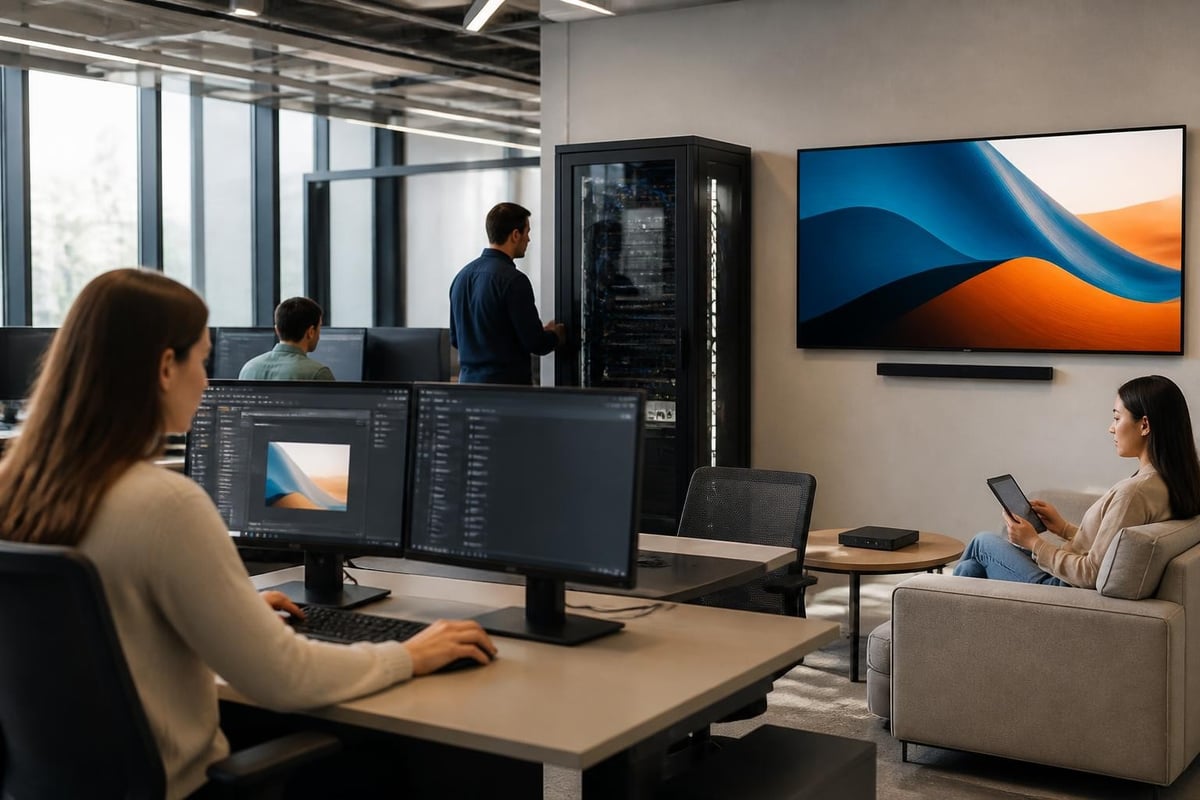
Content management systems (CMS) represent the software layer that controls what appears on screen. A robust CMS enables scheduling, multi-location management, real-time updates, and analytics. Cloud-based platforms have become standard, offering remote management and eliminating the need for on-premise servers.
Applications Across Industries
Digital signage display deployment varies dramatically by sector, each leveraging the technology to address specific operational and communication challenges.
Retail environments use digital displays for promotional content, wayfinding, and queue management. Dynamic pricing boards respond to inventory levels and competitor activity, whilst interactive kiosks guide product discovery. High-brightness window displays attract foot traffic even in direct sunlight, and shelf-edge screens deliver targeted product information at the point of decision.
Corporate settings deploy displays for internal communications, meeting room booking, and visitor management. Digital directories replace outdated static boards, automatically updating as organisations evolve. Performance dashboards visualise key metrics in real time, keeping teams aligned with business objectives.
Sector-Specific Deployments
| Industry | Primary Use Cases | Key Requirements |
|---|---|---|
| Healthcare | Wayfinding, appointment updates, health information | HIPAA compliance, accessibility features, 24/7 reliability |
| Education | Event calendars, emergency alerts, campus navigation | Integration with student systems, vandal resistance, remote management |
| Hospitality | Event schedules, promotional content, brand messaging | High-resolution imagery, multi-language support, aesthetic design |
| Transport | Departure boards, wayfinding, advertising | Outdoor durability, real-time data integration, high visibility |
Quick-service restaurants revolutionised menu boards with digital signage display technology, enabling daypart scheduling that automatically switches breakfast to lunch menus and highlights limited-time offers. Drive-through screens integrate with point-of-sale systems to personalise recommendations based on purchase history and current queue length.
Manufacturing facilities use industrial-grade displays for production metrics, safety messaging, and shift communications. Ruggedised enclosures protect screens from dust, moisture, and vibration whilst maintaining visibility in challenging lighting conditions.
Selecting the Right Display Technology
Choosing between LCD, LED, and emerging display technologies requires understanding both technical specifications and use-case requirements. Each technology offers distinct advantages that suit particular applications.
LCD panels dominate indoor digital signage display installations due to their cost-effectiveness, colour accuracy, and maturity. Modern commercial LCDs deliver excellent image quality at resolutions up to 8K, though 4K remains the practical sweet spot balancing clarity and content production costs. Anti-glare coatings and high-brightness variants address challenging lighting environments.
LED video walls excel where impact and scale matter. Comprising individual LED modules, these displays scale to virtually any size and shape, creating stunning visual centrepieces in retail, entertainment, and corporate settings. Fine-pitch LED (pixel pitches below 2mm) rivals LCD quality at viewing distances beyond one metre. The technology's modular nature simplifies maintenance-failed modules swap out without replacing entire panels.
Emerging Display Technologies
MicroLED technology promises to combine the best attributes of LCD and LED whilst eliminating their weaknesses. These self-emissive displays achieve perfect blacks, exceptional brightness, and superior energy efficiency. Though currently expensive and limited in availability, microLED represents the future of premium digital signage display solutions as manufacturing scales.
- OLED displays: Superior contrast and viewing angles but limited brightness and potential burn-in concerns restrict outdoor and 24/7 applications
- Transparent displays: Enable creative installations where content floats over physical products or views, though reduced brightness and contrast limit ambient light tolerance
- Flexible and curved screens: Create distinctive installations that wrap columns, follow architectural features, or form immersive environments
Outdoor digital signage display systems demand specialised engineering. Weatherproof enclosures (IP65 or higher), temperature regulation for extreme climates, and ultra-high brightness (2,500+ nits) ensure visibility and reliability. Anti-reflective coatings and automatic brightness adjustment maintain readability as ambient light changes throughout the day.
Content Strategy and Design Principles
Even the most advanced digital signage display delivers poor results without thoughtful content. Effective digital signage balances information density, visual appeal, and message duration to capture attention whilst respecting viewer time.
Research from Penn State's digital signage programme emphasises readability fundamentals: generous white space, high contrast between text and background, and font sizes exceeding 24 points for body text. Messages should communicate their core point within three seconds-the average dwell time for passive viewing.
Content Design Best Practices
Visual hierarchy guides viewer attention through size, colour, and positioning. Primary messages occupy the upper third of the screen, where eye-tracking studies show attention concentrates. Secondary information and calls-to-action follow naturally downward and rightward for Western audiences.
Animation attracts attention but must serve communication rather than distract. Subtle motion-a sliding headline, gentle fade, or animated icon-proves more effective than aggressive transitions. Content loops should vary length to avoid predictable patterns that trained viewers ignore.
Resolution and aspect ratio alignment prevents distortion and quality loss. A 1920×1080 display requires content at precisely that resolution for optimal sharpness. Creating content at higher resolutions then downscaling maintains quality whilst future-proofing assets for display upgrades.
Accessibility considerations extend digital signage display benefits to all viewers. Captions ensure audio content reaches those with hearing impairments or in sound-restricted environments. The W3C's WCAG2ICT guidance provides detailed requirements for making non-web technologies accessible, including appropriate colour contrast ratios, text alternatives for images, and timing controls for animated content.

Network Infrastructure and Security
Modern digital signage display systems rely on network connectivity for content distribution, remote management, and analytics. Network architecture directly impacts system reliability, content freshness, and security posture.
Bandwidth requirements scale with display count, content complexity, and update frequency. A single full-HD display streaming video continuously demands approximately 8-15 Mbps. Local content caching dramatically reduces ongoing bandwidth consumption-displays store frequently used content locally and fetch only updates. This approach also maintains operation during network disruptions.
Dedicated VLANs isolate digital signage display traffic from other network activities, preventing bandwidth contention and enhancing security. Network segmentation limits the blast radius should a display become compromised, protecting critical business systems.
Security Considerations
Digital signage displays represent potential attack vectors requiring proactive security measures. NIST guidance on IoT security provides frameworks applicable to endpoint devices including signage systems.
- Default credential management: Change all default passwords immediately upon deployment
- Firmware updates: Establish regular patching schedules for displays, players, and CMS platforms
- Network access control: Restrict which systems can communicate with displays
- Content source verification: Authenticate content origins to prevent unauthorised messaging
- Physical security: Secure display mounting and player access to prevent tampering
Cloud-based content management introduces additional security considerations. Encryption for data in transit and at rest protects content confidentiality. Multi-factor authentication for administrative access prevents unauthorised system changes. Audit logging tracks who made what changes when, supporting compliance and incident investigation.
For organisations with illuminated signage needs beyond digital displays, Lightbox Signage offers a complementary solution. These fabricated lightboxes provide constant brand visibility with lower operating costs than digital alternatives, making them ideal for exterior brand identification whilst digital screens handle dynamic interior communications.

Deployment Planning and Installation
Successful digital signage display deployment begins long before screens arrive on site. Comprehensive planning addresses power requirements, mounting specifications, viewing angles, and ambient lighting conditions.
Site surveys identify optimal placement that balances visibility, foot traffic patterns, and technical feasibility. Mounting height depends on viewing distance and content type-detailed information requires lower placement whilst general messaging tolerates higher mounting. ADA compliance in public spaces may dictate maximum protrusion from walls.
Power delivery options range from standard electrical outlets to Power over Ethernet (PoE) for smaller displays. PoE simplifies installation by delivering both data and power through a single cable, reducing installation costs and improving aesthetics. Larger displays require dedicated electrical circuits with appropriate amperage.
| Installation Consideration | Indoor | Outdoor |
|---|---|---|
| Minimum brightness (nits) | 350-500 | 2,500+ |
| Weatherproof rating | Not required | IP65 or higher |
| Operating temperature | 0-40°C | -30 to 50°C |
| Mounting security | Standard commercial | Anti-theft fasteners, tamper-resistant |
| Viewing distance | 1.5-3m typical | 3-10m+ typical |
Viewing angle specifications determine how well content remains visible from off-centre positions. IPS (In-Plane Switching) panels offer 178-degree viewing angles-virtually no colour shift or brightness reduction from any position. This matters tremendously in wide corridors, open retail spaces, or anywhere viewers approach from various directions.
Professional installation ensures displays mount securely, connect properly, and integrate cleanly with architecture. Weight loads, structural support, and seismic considerations vary by location and building codes. Cable management conceals wiring whilst maintaining accessibility for future service.
Measuring Performance and ROI
Digital signage display investments require justification through measurable outcomes. Modern systems provide analytics that transform these deployments from aesthetic improvements into accountable business tools.
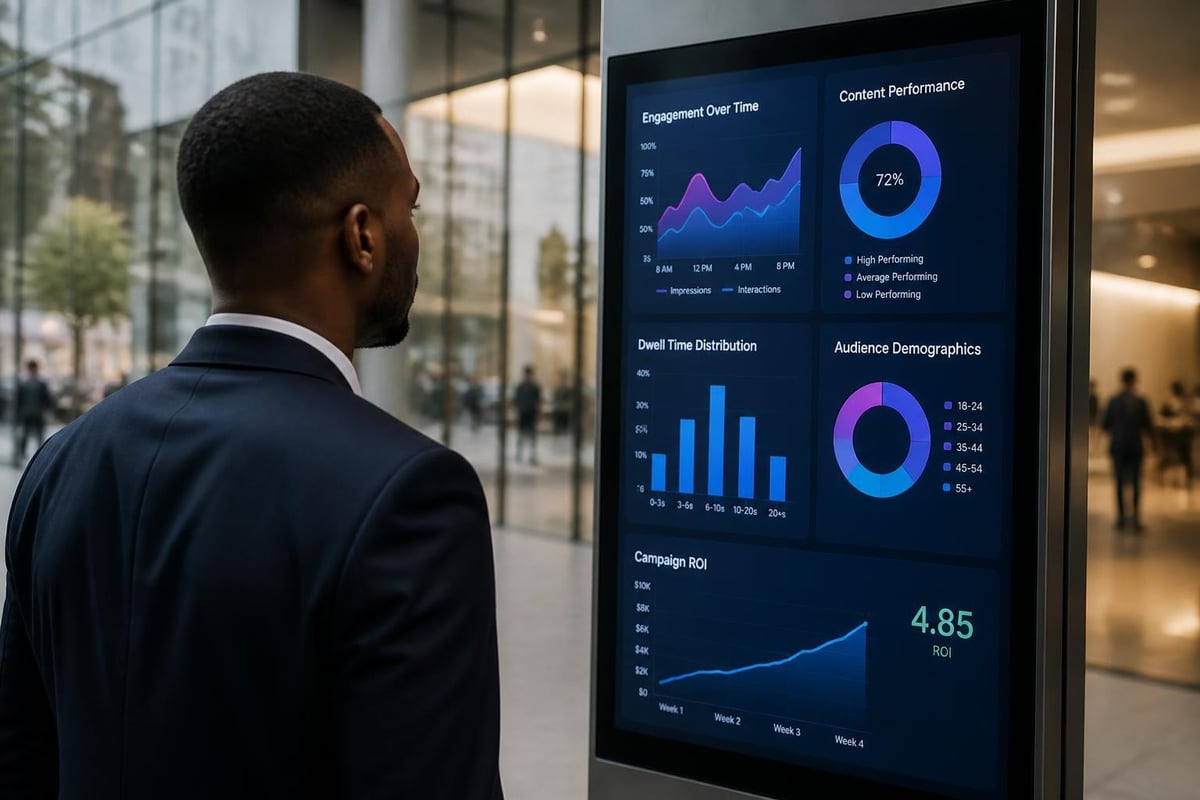
Audience measurement technologies determine viewer counts, dwell time, and demographic composition. Computer vision analyses camera feeds (respecting privacy through anonymisation) to count viewers, estimate age and gender, and track attention duration. This data correlates specific content with engagement levels, enabling continuous optimisation.
Proof-of-play reporting verifies content delivery, documenting exactly what played when and where. For advertising-supported deployments, this provides the audit trail advertisers demand. Internal communications teams use these reports to ensure critical messages reached their intended audiences.
Key Performance Indicators
Different objectives demand different metrics:
- Retail: Sales lift during promotional campaigns, product inquiry volume, average transaction value
- Corporate: Message recall surveys, employee satisfaction scores, meeting room utilisation rates
- Hospitality: Guest satisfaction ratings, upsell conversion, event attendance
- Healthcare: Wayfinding efficiency, missed appointment reduction, patient education engagement
A/B testing applies to digital signage as rigorously as to digital marketing. Split content between displays or time periods, then measure which variants drive desired behaviours. Iteration based on data transforms good content into exceptional results.
Return on investment calculations must account for both direct revenue impact and operational savings. Queue management systems reduce perceived wait times, improving satisfaction whilst optimising staff allocation. Automated scheduling eliminates the labour hours previously spent manually changing posters and notices.
Industry analysis from AVIXA tracks digital signage adoption and ROI across sectors, providing benchmarks against which organisations can compare their results. These third-party studies help justify initial investments and expansion decisions.
Future Trends Shaping Digital Signage
The digital signage display landscape continues evolving rapidly as technology advances and use cases expand. Understanding emerging trends helps organisations future-proof investments and capitalise on new capabilities.
Artificial intelligence transforms content from scheduled to responsive. AI analyses viewer reactions in real time, adapting content to maximise engagement. Weather, traffic, social media trends, and inventory levels automatically influence what appears on screen, ensuring relevance without manual intervention.
Interactivity deepens engagement through touchscreens, gesture recognition, and mobile integration. Shoppers build wish lists, compare products, and access detailed specifications. Museum visitors explore exhibits at their own pace, diving deeper into topics that interest them. The six top digital signage trends identified for 2024-2025 emphasise this shift towards personalised, interactive experiences.
Integration and Intelligence
Digital signage display systems increasingly integrate with broader technology ecosystems:
- Building management systems: Coordinate messaging with occupancy, events, and emergencies
- Customer data platforms: Personalise content based on loyalty status, purchase history, and preferences
- Business intelligence tools: Display real-time KPIs, alerts, and performance dashboards
- Voice assistants: Enable hands-free interaction and information retrieval
Programmatic advertising brings digital marketing's targeting sophistication to physical spaces. Advertisers bid in real time for display inventory, with placements determined by current audience composition, time of day, and campaign objectives. Venues monetise displays whilst maintaining control over content quality and brand alignment.
Sustainability considerations drive hardware and operational choices. Energy-efficient LED backlights, intelligent brightness adjustment, and responsible end-of-life recycling programmes reduce environmental impact. Content strategies emphasise lower motion and darker backgrounds to minimise power consumption-a black pixel uses no energy on OLED and microLED displays.
Standards development by organisations including SMPTE ensures interoperability between manufacturers and components. Open protocols prevent vendor lock-in, protecting long-term investments whilst encouraging innovation through competition.
Maintenance and Lifecycle Management
Proactive maintenance extends digital signage display lifespan and ensures consistent performance. Commercial displays typically offer 50,000-100,000 hour ratings-approximately 6-11 years of continuous operation-but actual longevity depends heavily on operating conditions and maintenance practices.
Cleaning protocols maintain image quality and professional appearance. Anti-static microfibre cloths remove dust without scratching. Avoid ammonia-based cleaners that damage anti-glare coatings; manufacturer-approved solutions or diluted isopropyl alcohol prove safer. Schedule cleaning during off-hours to avoid disturbing viewers.
Brightness calibration compensates for gradual luminance degradation. Displays lose 20-30% brightness over their rated lifetime, but non-uniform aging creates hot spots and colour shifts. Annual calibration maintains consistent appearance across multi-display installations and extends useful life before replacement becomes necessary.
Proactive Monitoring
Remote monitoring systems detect issues before they impact operations:
- Temperature sensors: Alert to cooling system failures before components overheat
- Power monitoring: Identify electrical anomalies that predict imminent failure
- Content verification: Confirm proper playback through screenshot sampling
- Network connectivity: Detect communication disruptions requiring intervention
- Display diagnostics: Track pixel failures, backlight status, and component health
Component-level monitoring enables predictive maintenance-replacing failing parts before complete breakdown. This scheduled approach minimises downtime and emergency service calls whilst optimising technician efficiency through route planning.
Refresh cycles balance technological advancement against investment depreciation. A five-to-seven-year replacement schedule captures significant technology improvements-higher resolution, better efficiency, enhanced features-whilst maximising initial investment value. Some organisations adopt rolling replacement programmes, updating one-third of displays annually to smooth capital expenditure.
Digital signage display technology offers businesses unprecedented flexibility in communicating with audiences whilst delivering measurable results that justify investment. As systems become more intelligent, integrated, and interactive, the gap between organisations that leverage these tools effectively and those that don't will only widen. Whether you're exploring your first digital signage display deployment or expanding an existing network, Signshoponline provides the expertise, products, and support to bring your vision to life with solutions tailored to your specific communication goals.


