


The way businesses communicate with customers has fundamentally changed. Static posters and printed notices have given way to dynamic, attention-grabbing screens that can update instantly, respond to audience behaviour, and deliver targeted messages at precisely the right moment. Display digital signage represents the convergence of hardware innovation, content strategy, and data-driven marketing, creating opportunities for businesses to engage audiences in ways that were impossible just a few years ago. Whether you're considering your first installation or optimising an existing network, understanding how to effectively display digital signage is essential for maximising return on investment and creating memorable customer experiences.
Understanding Display Digital Signage Technology
Display digital signage encompasses the complete ecosystem of screens, media players, content management systems, and network infrastructure that work together to deliver visual communications. At its core, this technology transforms ordinary displays into intelligent endpoints that can show everything from promotional content to wayfinding information, real-time data feeds, and interactive experiences.
Hardware Components and Selection Criteria
Choosing the right display hardware determines not only image quality but also longevity, energy efficiency, and total cost of ownership. Commercial-grade displays differ significantly from consumer televisions, featuring higher brightness ratings (typically 500-700 nits for indoor use, 2,500+ nits for outdoor), extended operational lifespans rated for 16-24 hour daily operation, and industrial-grade thermal management systems.
Key specifications to evaluate include:
- Screen resolution (Full HD, 4K, or 8K depending on viewing distance)
- Panel type (LCD, LED, OLED, or microLED)
- Brightness levels measured in nits
- Viewing angles and colour accuracy
- Warranty coverage and mean time between failures (MTBF)
When you display digital signage in high-traffic environments, durability becomes paramount. Commercial panels often include protective glass, anti-glare coatings, and tamper-resistant mounting systems. The ENERGY STAR guidance for Signage Displays provides valuable benchmarks for energy efficiency, helping organisations reduce operational costs whilst supporting environmental sustainability goals.
Media Players and Content Delivery Systems
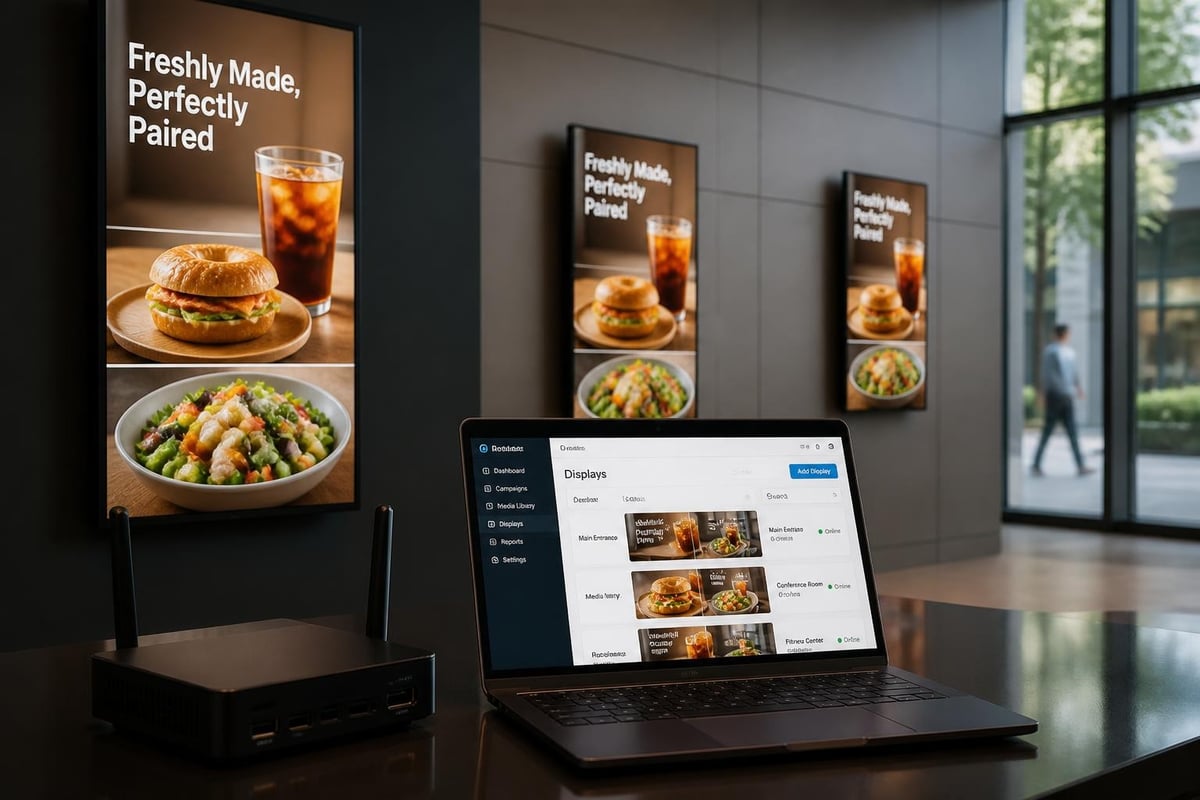
Behind every effective digital signage installation sits a media player responsible for content playback, scheduling, and network communication. These range from basic standalone players loaded with USB content to sophisticated systems-on-chip (SoC) displays with integrated computing power, and cloud-connected appliances that receive real-time updates.
Modern media players must handle increasingly complex demands: high-resolution video playback, web-based content rendering, data feed integration, and responsive layout adjustments. The choice between cloud-based and on-premises content management systems (CMS) affects everything from initial costs to ongoing maintenance requirements and content update workflows.
| Deployment Model | Best For | Key Advantage | Primary Consideration |
|---|---|---|---|
| Cloud-based CMS | Multi-location networks | Remote management | Internet dependency |
| On-premises server | Secure environments | Full data control | IT infrastructure required |
| Hybrid architecture | Enterprise deployments | Flexibility and redundancy | Complexity management |
| Standalone players | Single-screen installations | Simplicity | Manual updates |
Strategic Placement and Installation Considerations
Where you position displays fundamentally shapes their effectiveness. The best digital signage display draws eyes naturally, delivers messages when audiences are most receptive, and integrates seamlessly into the physical environment. Strategic placement considers sightlines, ambient lighting, traffic flow patterns, and dwell time.
Optimising Viewing Conditions
Screen height, angle, and distance determine whether your content reaches its intended audience. Industry standards suggest mounting displays with the centre at eye level (approximately 1.5-1.7 metres for standing viewers) and angling screens slightly downward in high-mounted installations to reduce glare and improve visibility.
Ambient lighting presents both challenges and opportunities when you display digital signage. Bright retail environments require higher-brightness panels, whilst restaurants and entertainment venues can use lower brightness levels that create atmosphere without overwhelming diners. Light sensors and automatic brightness adjustment help maintain optimal visibility throughout the day whilst reducing energy consumption during low-light periods.
Traffic pattern analysis reveals optimal placement zones. High-value locations include:
- Decision points where customers choose between paths
- Queue areas where dwell time exceeds 30 seconds
- Entry zones during the first impression window
- Checkout areas during transaction wait times
- Waiting rooms and lounges with extended occupancy
Research from POPAI on shopper engagement demonstrates that strategically placed digital displays can influence purchase decisions at the critical moment when customers are actively evaluating options.
Environmental and Technical Infrastructure
Installation planning extends beyond mounting brackets and power outlets. Network connectivity, content update mechanisms, thermal management, and maintenance access all require advance planning. Wired Ethernet connections provide the most reliable performance for display digital signage, though modern Wi-Fi infrastructure can support smaller deployments effectively.
Climate control affects display longevity significantly. Commercial displays generate substantial heat, and enclosed installations require ventilation planning. Outdoor displays face additional challenges from temperature extremes, moisture, and direct sunlight, necessitating weatherproof enclosures and enhanced cooling systems.

Content Strategy and Design Principles
Hardware excellence means nothing without compelling content. The most sophisticated display digital signage installation delivers mediocre results when content fails to engage, inform, or persuade. Effective content strategy balances brand messaging, audience needs, and environmental context to create moments of meaningful connection.
Message Hierarchy and Visual Communication
Digital signage operates under the "3-second rule": you have three seconds or less to capture attention and communicate your primary message. This constraint demands ruthless prioritisation and visual clarity. Effective layouts establish clear hierarchy through size, colour, contrast, and positioning.
Content design best practices include:
- Single primary message per screen or zone
- High-contrast text against backgrounds (minimum 4.5:1 ratio)
- Large, readable typefaces (minimum 24-point for body text)
- Strategic use of motion to attract attention without distraction
- Consistent branding elements that reinforce identity
The W3C's Web Content Accessibility Guidelines provide valuable frameworks for creating content that serves diverse audiences, including those with visual impairments or colour blindness. Whilst developed for web content, these principles apply directly when you display digital signage in public spaces.
Dynamic Content and Real-Time Integration
Static digital signage wastes the technology's core advantage: the ability to change messages instantly based on time, context, or audience. Dynamic content strategies leverage scheduling, data feeds, and conditional logic to deliver relevant messages at optimal moments.
For retailers, this might mean breakfast promotions during morning hours, lunch specials at midday, and dinner offerings as the evening approaches. Corporate environments can display meeting room schedules, employee recognition, and emergency alerts as situations demand. Transport hubs integrate real-time arrival information with advertising content, creating utility that increases viewer engagement with commercial messages.
Social media integration brings user-generated content and live feeds into your signage network, creating freshness and social proof. Weather data, news headlines, sports scores, and stock tickers provide contextual relevance that keeps content feeling current and worth watching.
When combined with Fabricated 3d Signage, digital displays create a comprehensive branded environment that combines the tangibility and permanence of dimensional lettering with the dynamism of changeable digital content, delivering maximum visual impact.

Security and Compliance Considerations
As display digital signage becomes increasingly connected and sophisticated, security vulnerabilities multiply. Networked displays represent potential entry points for cyber attacks, data breaches, and content manipulation. Comprehensive security planning protects both your infrastructure and your audience.
Network Security and Access Control
Digital signage systems often connect to corporate networks, creating pathways that attackers might exploit to access sensitive data or distribute malware. Network segmentation isolates signage infrastructure from critical business systems, limiting potential damage from compromised devices.
The HKCERT IoT Security Guideline for Digital Signage outlines practical security measures including default password changes, firmware update protocols, and network access restrictions. Regular security audits identify vulnerabilities before they're exploited.
Essential security measures include:
- Strong authentication for content management systems
- Encrypted communications between players and servers
- Regular firmware and software updates
- Physical security for media players and network equipment
- Content approval workflows to prevent unauthorised messaging
Emerging threats documented in the HKCERT Security Watch Report highlight how digital signage systems face increasing attack sophistication, making proactive security essential rather than optional.
Accessibility and Legal Compliance
When you display digital signage in public spaces, accessibility obligations apply. The W3C note on applying WCAG to non-web ICT provides guidance for making digital signage accessible to people with disabilities, covering text alternatives for visual content, sufficient colour contrast, and readable text sizing.
Legal requirements vary by jurisdiction and installation context. Government buildings, healthcare facilities, and educational institutions often face stricter accessibility standards than purely commercial environments. The U.S. Department of Justice ADA resources offer frameworks for compliance planning, though local regulations should always be verified.
Performance Measurement and Optimisation
Effective display digital signage programmes incorporate measurement frameworks that connect screen performance to business objectives. Without data, optimisation becomes guesswork. Modern analytics platforms provide unprecedented visibility into how audiences interact with digital content.
Audience Analytics and Engagement Metrics
Computer vision and sensor technologies enable anonymous audience measurement that respects privacy whilst delivering actionable insights. These systems detect viewer presence, estimate demographics, track attention duration, and measure conversion actions.
| Metric | What It Measures | Why It Matters |
|---|---|---|
| Impressions | Number of potential viewers | Reach and visibility assessment |
| Dwell time | How long viewers watch | Content engagement quality |
| Attention rate | Percentage who actively view | Message effectiveness indicator |
| Conversion actions | QR scans, purchases, enquiries | Business impact measurement |
| Play-through rate | Video completion percentage | Content optimisation signal |
Programmatic digital out-of-home (DOOH) advertising brings the targeting and measurement sophistication of online advertising to physical displays. The IAB's DOOH definition and measurement guidance establishes industry standards for audience measurement and campaign attribution, enabling more sophisticated ROI calculations.
Content Performance and A/B Testing
Data-driven content optimisation treats your display digital signage network as a laboratory for continuous improvement. A/B testing compares different messages, layouts, or calls-to-action to identify what resonates most effectively with your audience.
Testing variables might include headline phrasing, colour schemes, image versus video content, or promotional offer structures. Statistical significance requires sufficient sample sizes and controlled test conditions, but the insights gained can dramatically improve campaign performance.
According to PwC's Global Entertainment & Media Outlook, digital out-of-home advertising continues robust growth through 2026, driven partly by enhanced measurement capabilities that demonstrate clear return on advertising spend. Businesses that leverage these analytics tools can justify investment and optimise spending allocation across channels.
Integration with Broader Marketing Ecosystems
Display digital signage achieves maximum impact when integrated with other marketing channels rather than operating in isolation. Cross-channel strategies create consistent customer experiences and reinforce messages through multiple touchpoints.
Omnichannel Customer Journeys
Modern customers move fluidly between online and physical environments, expecting consistent messaging and seamless experiences. Digital signage that reflects online promotions, acknowledges social media campaigns, or continues stories begun in email marketing creates cohesion that strengthens brand perception.
QR codes and NFC tags bridge the physical-digital divide, enabling customers to capture information, access exclusive content, or complete transactions initiated at a display. Personalisation engines can adjust displayed content based on aggregated data from loyalty programmes, creating relevant experiences without compromising individual privacy.
Mobile integration extends display digital signage beyond the screen. Bluetooth beacons trigger smartphone notifications as customers approach displays, location-based apps provide complementary information, and augmented reality applications layer digital content onto physical environments through camera viewfinders.
Data Flow and CRM Integration
Customer relationship management systems, point-of-sale data, inventory levels, and operational metrics all provide valuable inputs for intelligent signage content. Displaying real-time stock availability prevents customer frustration with unavailable products, whilst promoting items with surplus inventory helps optimise turnover.
Event triggering enables responsive messaging based on business conditions. Temperature sensors might activate cold beverage promotions during heat waves, queue length detection could display entertainment content during long waits, and proximity sensors might adjust content as VIP customers approach.
Maintenance and Lifecycle Management
Professional display digital signage installations require ongoing maintenance, content refreshes, and eventual hardware upgrades. Lifecycle planning prevents deteriorating experiences and budget surprises.
Preventive Maintenance Protocols
Regular maintenance extends hardware life and prevents embarrassing failures. Professional cleaning removes dust accumulation that affects cooling efficiency, connection checks identify loose cables before they cause outages, and software updates patch security vulnerabilities whilst adding new features.
Recommended maintenance schedule:
- Weekly: Visual inspection for display issues or physical damage
- Monthly: Connection verification and cable inspection
- Quarterly: Deep cleaning of displays and ventilation systems
- Bi-annually: Software updates and security patches
- Annually: Comprehensive system audit and performance review
Remote monitoring systems alert administrators to failures, performance degradation, or security events, enabling rapid response before minor issues become major problems. Predictive maintenance uses operational data to identify components approaching end-of-life, allowing scheduled replacement rather than emergency repairs.
Content Refresh and Relevance
Even the most engaging content eventually becomes stale. Regular content updates maintain viewer interest and signal that your business remains active and current. Seasonal campaigns, product launches, and promotional cycles provide natural refresh opportunities.
Content calendars synchronise digital signage with broader marketing initiatives, ensuring consistency and planning efficiency. Template libraries accelerate content creation whilst maintaining brand standards, and approval workflows prevent inappropriate or off-brand messaging from reaching screens.
Future Trends Shaping Digital Signage
The technology landscape continues evolving rapidly. Understanding emerging trends helps organisations make investment decisions that remain relevant as capabilities advance and audience expectations shift.
Artificial intelligence increasingly powers content personalisation, object recognition, and autonomous creative generation. Machine learning algorithms optimise content scheduling based on historical performance, whilst generative AI tools create variations tailored to specific audience segments or contexts.
Interactive displays evolve beyond simple touchscreens to incorporate gesture recognition, voice commands, and emotional response detection. These technologies create engaging experiences whilst generating valuable data about customer preferences and behaviour patterns.
Sustainability concerns drive adoption of energy-efficient display technologies, solar-powered installations, and content strategies that reduce unnecessary screen-on time. Organisations increasingly view display digital signage through environmental lenses, balancing communication effectiveness against ecological impact.
The line between digital signage and other technologies continues blurring. Displays incorporate retail transaction capabilities, wayfinding systems integrate with navigation apps, and public information screens connect to emergency alert networks. This convergence creates opportunities for functionality that serves multiple purposes from single installations.
Display digital signage represents a powerful communication channel when deployed strategically with attention to hardware selection, content quality, security, and measurement. The technology continues evolving rapidly, offering increasingly sophisticated capabilities for businesses that invest in understanding both the technical infrastructure and the strategic frameworks that drive results. Whether you're implementing your first display or expanding an existing network, Signshoponline provides comprehensive digital signage solutions alongside traditional signage options, helping businesses create cohesive visual communications that engage customers and drive measurable outcomes.


