


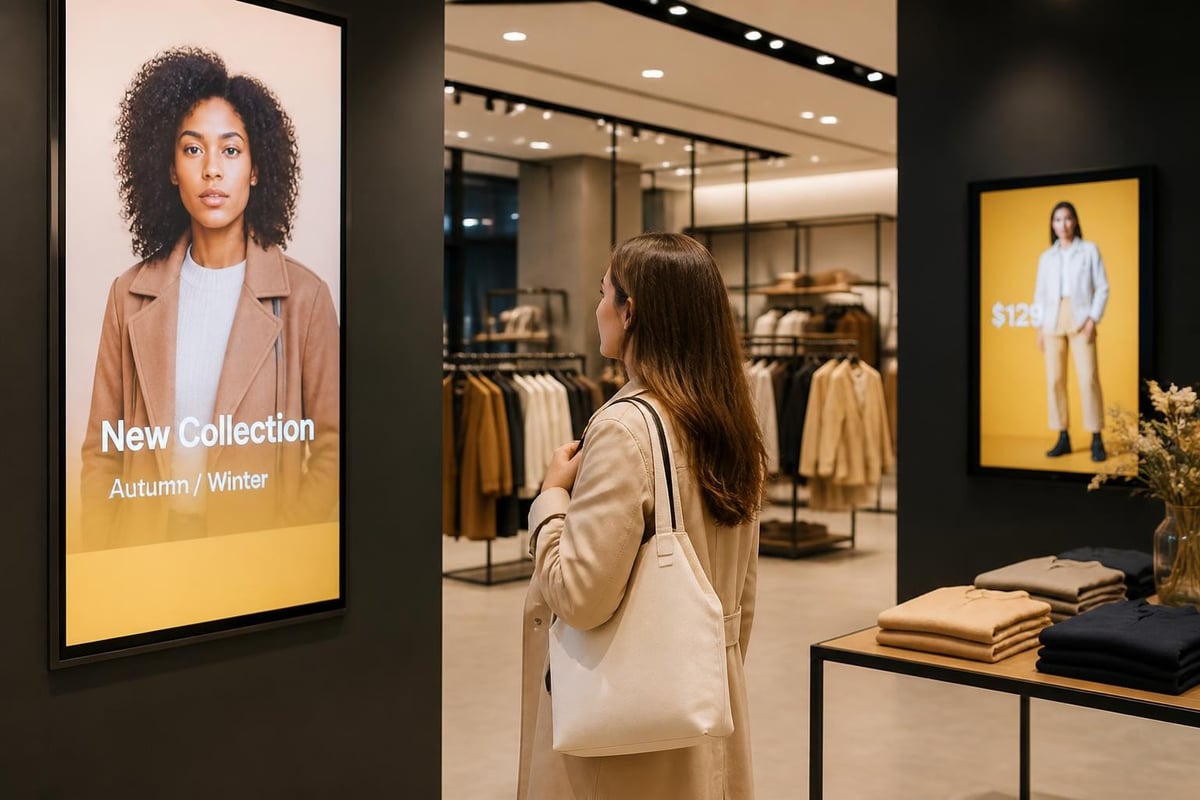
The retail landscape has fundamentally shifted towards experiential shopping, where customers expect immersive, personalised interactions that bridge the gap between digital convenience and physical presence. In store digital signage has emerged as a critical technology that transforms static retail environments into dynamic, responsive spaces that communicate with shoppers in real time. According to Deloitte's 2025 Retail Industry Outlook, retailers are accelerating investments in connected store technologies, with digital displays becoming central to the omnichannel experience. This convergence of physical and digital touchpoints creates opportunities for businesses to deliver contextual content, influence purchasing decisions at critical moments, and gather valuable insights about customer behaviour within the store environment.
Understanding In Store Digital Signage Technology
In store digital signage encompasses a spectrum of display technologies deployed throughout retail environments to inform, engage, and guide customers. These systems range from simple LCD screens showing promotional content to sophisticated networks of interactive displays, video walls, and shelf-edge screens coordinated through centralised content management platforms.
The core components include display hardware (LED, LCD, or projection systems), media players that decode and render content, network infrastructure for content distribution, and software platforms that schedule, manage, and analyse display performance. Modern systems integrate with inventory databases, point-of-sale systems, and customer relationship management tools to deliver personalised messaging based on real-time data.
Hardware Considerations
Selecting appropriate display technology depends on environmental factors, viewing distances, and content requirements:
- Commercial-grade LCD panels: Designed for continuous operation (16-24 hours daily) with higher brightness levels than consumer displays
- LED video walls: Seamless large-format displays ideal for high-impact zones and brand storytelling
- Transparent OLED screens: Enable product displays behind the screen, creating layered visual experiences
- Outdoor-rated displays: Weather-resistant units with enhanced brightness for window displays and external signage
- Interactive touchscreens: Facilitate product exploration, wayfinding, and self-service applications
Display placement strategy determines effectiveness. High-traffic areas near entrances capture attention and set expectations, whilst end-cap displays influence purchasing decisions at the point of consideration. Queue management screens in checkout areas reduce perceived wait times whilst promoting impulse purchases or loyalty programme enrolment.
| Display Type | Typical Application | Viewing Distance | Key Advantage |
|---|---|---|---|
| Window displays | Brand messaging, promotions | 3-10 metres | Attract foot traffic |
| Shelf-edge screens | Product details, pricing | 0.5-2 metres | Contextual information |
| Wayfinding kiosks | Navigation, search | 0.5-1.5 metres | Interactive engagement |
| Video walls | Immersive experiences | 5-15 metres | High visual impact |
Strategic Applications That Drive Results
In store digital signage serves multiple strategic objectives simultaneously, making it one of the most versatile tools in the modern retail environment. The most effective deployments align technology capabilities with specific business outcomes rather than implementing displays simply because competitors have them.
Promotional messaging represents the most common application, yet many retailers fail to optimise this channel. Dynamic content outperforms static signage by enabling time-based messaging that responds to traffic patterns, inventory levels, and external factors such as weather or local events. A fashion retailer might promote rainwear when precipitation is forecast, whilst a grocery store can highlight barbecue supplies on sunny weekend mornings.
Product education addresses the challenge of reduced floor staff whilst maintaining customer service quality. Detailed specification sheets, demonstration videos, and comparison tools empower customers to make informed decisions independently. This application proves particularly valuable for technical products where features require explanation or for categories with extensive choice where customers benefit from guided selection.
Enhancing Customer Experience
In store digital signage fundamentally reshapes how customers navigate and interact with retail spaces. Research on retail technology trends highlights that shoppers increasingly expect digital experiences in physical stores, with interactive displays ranking amongst the most valued features.
Wayfinding solutions reduce frustration in large-format stores by providing interactive maps, product location search, and department information. These systems integrate with inventory databases to confirm product availability before customers traverse the store, saving time and improving satisfaction.
Social proof displayed through customer reviews, user-generated content, and real-time social media feeds builds credibility and trust. Displaying Instagram posts featuring your products creates authentic connection whilst encouraging customers to share their own experiences. Ratings and testimonials presented near featured products can increase conversion rates by addressing purchase hesitation at the critical moment.
Queue management transforms wait time from a negative experience into an engagement opportunity. Digital displays in checkout areas can show entertaining content, highlight complementary products, promote loyalty programmes, or display countdown timers that reduce perceived wait duration.
Content Strategy and Management
The technological sophistication of in store digital signage means little without compelling content that resonates with your audience. Many retailers invest heavily in hardware whilst underestimating the ongoing content creation and curation required to maintain effectiveness.
Content strategy begins with understanding customer journey stages within your store. Awareness content near entrances differs fundamentally from consideration content in product aisles and decision content at the point of purchase. Each zone requires tailored messaging that matches customer mindset and information needs at that moment.
Creating Effective Content
Successful digital signage content adheres to principles that differ from traditional advertising or web content:
- Brevity: Shoppers typically view screens for 3-8 seconds; messages must communicate instantly
- Visual hierarchy: Bold headlines, high-contrast colours, and minimal text ensure readability from distance
- Motion: Subtle animation attracts attention without overwhelming; excessive movement causes fatigue
- Relevance: Contextual content based on location, time, and audience demographics outperforms generic messaging
- Refresh frequency: Regular content updates prevent habituation and maintain customer interest
Production workflows must balance quality with volume. Template-based systems enable rapid creation of promotional content whilst maintaining brand consistency. User-generated content supplements professionally produced material, adding authenticity without significant production costs.
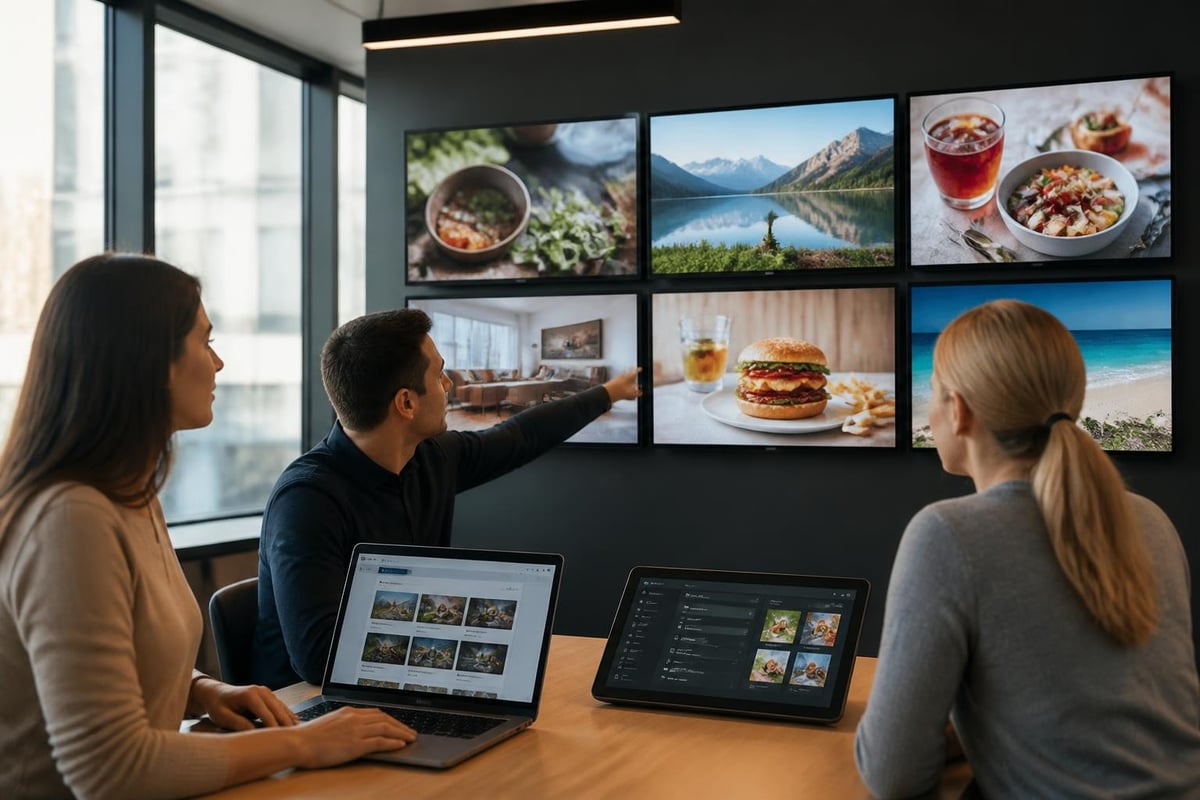
Centralised content management platforms provide scheduling capabilities, ensuring appropriate messages display at optimal times. A café might promote breakfast items until 11:00, transition to lunch offerings, then highlight evening selections. Seasonal content, flash sales, and event-driven messaging can be deployed instantly across entire store networks.
Measurement and Optimisation
In store digital signage generates measurable business impact when properly instrumented and analysed. The IAB Digital Out-Of-Home Measurement Guide provides authoritative standards for measuring display performance, applicable to retail environments seeking to quantify signage effectiveness.
Impression metrics quantify reach by counting viewers through computer vision, passive sensors, or mobile device detection. These systems distinguish between people passing displays versus those who actively view content, providing accurate audience measurement comparable to digital advertising metrics.
Engagement metrics measure interaction with touchscreen displays, QR code scans, or mobile app launches triggered by signage. Dwell time analysis reveals which content holds attention, whilst heatmapping shows where viewers focus within the display area.
| Metric Category | What It Measures | Why It Matters |
|---|---|---|
| Impressions | Number of viewers exposed to content | Reach and awareness |
| Dwell time | Duration viewers engage with display | Content effectiveness |
| Conversion | Actions taken after viewing (scans, purchases) | Business impact |
| Content performance | Which messages drive best results | Optimisation insights |
Attribution connects signage exposure to purchasing behaviour by correlating display impressions with transaction data. Point-of-sale integration reveals whether customers who viewed promotional content subsequently purchased featured products, enabling ROI calculation for specific campaigns.
Continuous optimisation requires systematic testing. A/B testing different creative approaches, messaging strategies, or content formats reveals what resonates with your specific audience. Geographic performance analysis across multiple locations identifies regional preferences and enables localised content strategies.
Integration With Broader Marketing Ecosystem
In store digital signage achieves maximum impact when integrated with other marketing channels rather than operating in isolation. This omnichannel approach creates cohesive customer experiences that reinforce messaging across touchpoints.
Social media integration extends campaign reach by displaying Instagram feeds, Twitter mentions, or TikTok content that features your brand. Encouraging customers to share their in-store experiences with specific hashtags creates authentic content whilst building community. Real-time social feeds demonstrate brand vitality and customer enthusiasm.
Email and mobile coordination enables personalised experiences where customers receive offers via email or app, then encounter complementary messaging on in-store displays. Geolocation technology can trigger mobile notifications when customers approach displays showcasing products they've previously browsed online, creating seamless digital-to-physical transitions.
Many retailers underestimate the power of coordinating in store digital signage with traditional illuminated displays. For instance, Lightbox Signage can be strategically combined with digital screens to create layered visual experiences where static branding elements complement dynamic content displays, maximising visual impact whilst controlling technology costs.
Retail Media Networks
Progressive retailers monetise in store digital signage by selling advertising space to brand partners, creating retail media networks that generate new revenue streams. IAB Europe's analysis of retail media demonstrates how in-store networks differ from traditional DOOH, offering brands access to high-intent shoppers at the point of purchase.
This model requires balancing advertiser content with retailer messaging to maintain customer experience quality. Clear guidelines govern content standards, frequency caps, and category exclusivity. Advanced systems enable brands to target specific demographics, dayparts, or store locations, increasing relevance and advertising value.
Accessibility and Compliance Considerations
In store digital signage must comply with accessibility standards ensuring all customers can benefit regardless of physical abilities. The ADA technical guidance on signs provides requirements relevant to electronic displays, including considerations for contrast ratios, text sizing, and audio alternatives for visual content.
Visual accessibility requires sufficient contrast between text and backgrounds, avoiding colour combinations problematic for colour-blind individuals, and ensuring text sizing remains readable from stated viewing distances. Sans-serif typefaces with medium weight provide optimal legibility.
Audio considerations include providing captions for video content and avoiding audio that interferes with customer service interactions or accessibility features like store navigation apps for visually impaired customers. Interactive displays should incorporate screen reader compatibility for touch interfaces.
Placement standards ensure displays don't create obstacles in accessible pathways and that interactive screens position controls within reach ranges specified by accessibility guidelines. Mounting heights and approach spaces require careful planning during installation.
Implementation Planning and Best Practices
Successful in store digital signage deployment requires methodical planning addressing technical, operational, and strategic dimensions. Rushed implementations often result in underutilised systems that fail to deliver expected returns.
Phased Rollout Approach
Starting with pilot locations enables learning before full-scale deployment:
- Phase 1: Single location with limited displays testing content strategies and measuring customer response
- Phase 2: Expanded deployment to 3-5 locations validating technical infrastructure and content workflows
- Phase 3: Network-wide rollout incorporating lessons learned and optimised processes
- Phase 4: Continuous enhancement based on performance data and evolving capabilities
Technical infrastructure planning must address network bandwidth, power requirements, mounting structures, and maintenance access. Cloud-based content management systems reduce local IT requirements whilst enabling centralised control, but require reliable internet connectivity with appropriate bandwidth for content distribution.
Vendor selection impacts long-term success significantly. Evaluate providers based on hardware reliability, software capabilities, support responsiveness, and upgrade pathways. Total cost of ownership includes initial equipment, installation, ongoing content production, software licensing, maintenance, and eventual replacement cycles typically spanning 5-7 years.
Content Governance and Workflow
Establishing clear content governance prevents inconsistent messaging and ensures brand standards. Define approval workflows, content calendars, and responsibilities for creation, review, and deployment.
Brand guidelines adapted for digital signage specify colour palettes, typography, logo usage, animation styles, and messaging tone. These standards ensure consistency across locations whilst allowing flexibility for local relevance where appropriate.
Production templates streamline creation by providing pre-designed layouts for common content types (promotional offers, product features, event announcements). Marketing teams populate templates with specific details rather than designing from scratch, accelerating production whilst maintaining quality.
According to Shopify's retail signage guide, effective signage strategies combine thoughtful placement with compelling content and regular performance measurement. Their research emphasises that successful retailers treat digital signage as a dynamic communication channel requiring ongoing attention rather than a one-time installation project.
Future Developments and Emerging Capabilities
In store digital signage continues evolving as display technology, artificial intelligence, and data integration capabilities advance. Retailers planning 2026 deployments should consider emerging trends that may influence strategic decisions.
Artificial intelligence enables dynamic content optimisation where systems automatically adjust messaging based on real-time audience demographics detected through computer vision. AI-powered content generation can create personalised product recommendations displayed as customers browse specific aisles.
Augmented reality integration allows customers to use smartphones or AR glasses to see additional product information, virtual try-on experiences, or contextual details overlaid on physical displays. This technology bridges digital screens with the broader environment.
Sustainability features include energy-efficient display technologies, solar-powered outdoor units, and content management systems that reduce unnecessary display operation. Many retailers highlight sustainability commitments through digital signage itself, creating transparency about environmental initiatives.
The convergence of digital signage with other technologies creates increasingly sophisticated retail environments. Integration with mobile apps, beacon technology, computer vision, and point-of-sale systems enables experiences where the entire store responds dynamically to individual customers, delivering personalised service at scale.
Industry data from the Out of Home Advertising Association demonstrates the remarkable growth trajectory of digital out-of-home advertising, with in-store networks representing a significant component of this expansion as retailers recognise the value of the attention economy within their own spaces.
In store digital signage represents a powerful tool for retailers seeking to create engaging, informative, and dynamic shopping environments that meet modern customer expectations whilst driving measurable business results. By thoughtfully integrating displays with broader marketing strategies, maintaining compelling content, and continuously optimising based on performance data, businesses can transform static retail spaces into responsive environments that communicate effectively with every visitor. Whether you're planning your first digital display or expanding an existing network, Signshoponline provides comprehensive signage solutions including digital displays, custom fabrication, and illuminated options tailored to your specific retail environment and business objectives.


