


Illuminated signage has revolutionised the way businesses communicate with their customers, and lightboxes stand at the forefront of this transformation. These versatile display solutions combine strategic lighting technology with high-quality graphics to create eye-catching advertisements that work around the clock. Whether positioned outside a retail storefront, inside a shopping centre, or at a transport hub, lightboxes deliver consistent brand visibility that traditional signage simply cannot match. Understanding the technical aspects, design considerations, and strategic applications of these illuminated displays enables businesses to make informed decisions that maximise their marketing investment.
Understanding Lightbox Technology and Construction
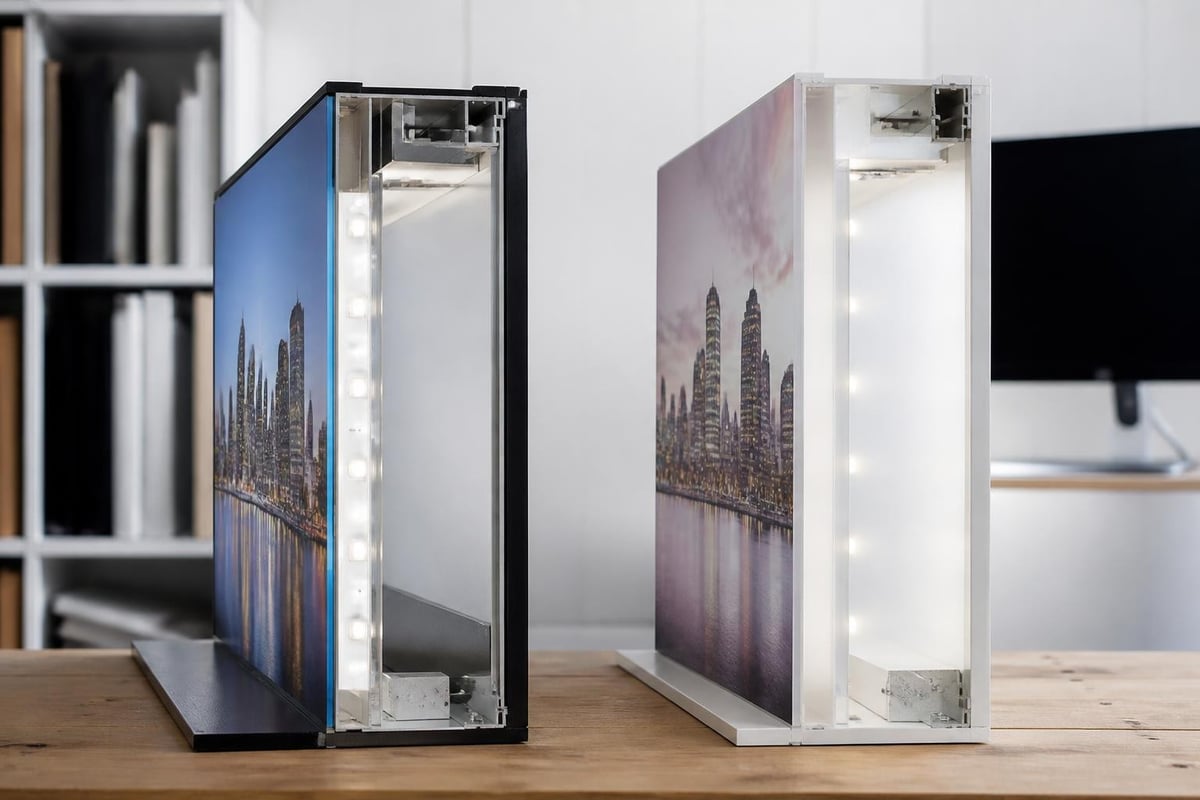
Modern lightboxes represent a sophisticated marriage of engineering precision and visual design. At their core, these displays consist of a frame housing, an illumination source, and a graphic face that diffuses light evenly across the display surface. The evolution from fluorescent tube lighting to LED technology has transformed the industry, offering businesses superior energy efficiency, longer operational lifespans, and more consistent colour rendering.
The construction methodology varies significantly depending on application requirements. Acrylic return lightboxes feature a sleek profile where the acrylic face wraps around the edges, creating a contemporary aesthetic particularly suited to modern retail environments. Alternatively, Mae-West construction utilises a deeper profile with exposed aluminium returns, providing enhanced durability for outdoor installations and high-traffic areas.
LED Illumination Systems
The shift towards LED lighting systems has redefined what's possible with lightbox signage. Unlike traditional fluorescent tubes that produce uneven lighting and require frequent replacement, LED modules deliver uniform illumination whilst consuming up to 75% less energy. The International Commission on Illumination provides standardised terminology for backlight performance, helping specifiers compare different systems objectively.
LED configurations typically fall into three categories:
- Edge-lit systems position LEDs around the perimeter, using light guides to distribute illumination across the face
- Back-lit arrays place LED strips directly behind the graphic substrate for maximum brightness
- Modular panels allow sections to be replaced independently, reducing maintenance costs
Temperature management remains critical for LED longevity. Quality lightboxes incorporate aluminium heat sinks and ventilation systems that dissipate thermal energy, ensuring the LEDs operate within optimal temperature ranges. This attention to thermal engineering directly impacts both the colour consistency and operational lifespan of your signage investment.
Types of Lightboxes for Different Applications
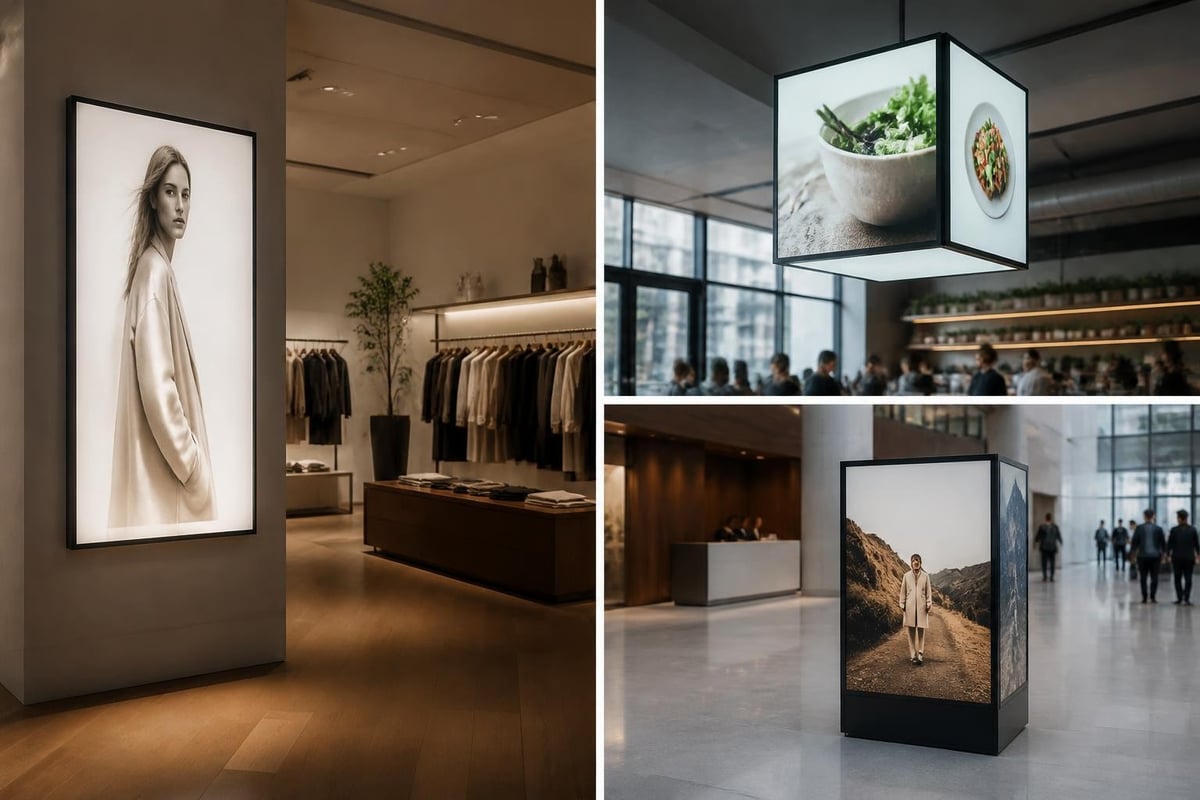
The versatility of lightbox technology has spawned numerous specialised formats, each optimised for specific business requirements and installation environments. Selecting the appropriate type requires careful consideration of viewing distance, ambient lighting conditions, and desired visual impact.
Single-Sided and Double-Sided Configurations
Single-sided lightboxes project graphics in one direction, making them ideal for wall-mounted installations or locations where viewing occurs from a defined approach angle. These units typically measure between 50mm and 150mm in depth, depending on the illumination system and structural requirements.
Double-sided lightboxes serve locations with bidirectional foot traffic, such as shopping centre corridors or suspended installations above pedestrian thoroughfares. These displays require more robust structural engineering to support the additional weight and ensure even illumination on both faces simultaneously.
| Configuration | Typical Depth | Best Applications | Visibility Range |
|---|---|---|---|
| Single-sided (edge-lit) | 50-75mm | Wall mounting, interior retail | Up to 15 metres |
| Single-sided (back-lit) | 100-150mm | Outdoor facades, high-impact zones | Up to 30 metres |
| Double-sided | 150-250mm | Suspended, pole-mounted | 360° viewing |
| Scrolling/rotating | 200-300mm | High-traffic advertising spaces | Variable rotation |
Freestanding and Modular Systems
Freestanding lightboxes offer exceptional flexibility for businesses requiring portable promotional displays or temporary installations. These units typically incorporate weighted bases and may include wheels for repositioning. They prove particularly valuable for exhibitions, events, or retail environments where seasonal displays require regular updates.
Modular lightbox systems allow businesses to create large-scale visual walls by connecting multiple units into seamless arrays. The IEC standards for display lighting provide measurement protocols that ensure colour consistency when multiple lightboxes are combined, preventing unsightly variations in brightness or colour temperature across the installation.
Design Considerations for Maximum Impact
Effective lightbox design requires more than simply illuminating existing artwork. The interaction between light source, graphic substrate, and viewing environment demands careful planning to achieve optimal results. Professional designers account for light transmission properties, colour saturation under illumination, and the psychological impact of brightness levels on viewer perception.
Graphic Production and Material Selection
The substrate carrying your graphic plays a crucial role in the final appearance of illuminated signage. Backlit vinyl remains the industry standard for most applications, offering excellent light transmission whilst maintaining colour vibrancy and durability. Premium vinyl formulations incorporate UV inhibitors that prevent colour shift and material degradation, particularly important for exterior installations subject to direct sunlight.
Alternative materials serve specialised requirements:
- Translucent fabric systems create softer, more diffused illumination ideal for hospitality and premium retail environments
- Rigid substrates such as acrylic or polycarbonate suit applications requiring frequent graphic changes or enhanced vandal resistance
- Perforated window films enable storefront lightboxes whilst maintaining outward visibility from inside
The ISO technical specification for light stability testing provides frameworks for evaluating how graphics perform under continuous illumination, helping businesses select materials that maintain appearance over extended operational periods.
Colour Management and Brightness Optimisation
Colours behave differently under illumination compared to reflective viewing conditions. Designers must account for this transformation during the creative process, often adjusting saturation and contrast to compensate for the backlit environment. High-quality colour profiling ensures printed graphics match design intent when the lightbox is energised.
Brightness levels require calibration based on ambient lighting conditions. Interior retail lightboxes typically operate at 3,000-5,000 lumens per square metre, whilst exterior installations facing direct sunlight may require 10,000 lumens or more to maintain visibility. Dimming controls allow businesses to adjust intensity based on time of day, conserving energy during peak natural light hours whilst maximising impact during evening periods.
Installation and Mounting Solutions
Professional installation determines both the aesthetic success and operational safety of lightbox signage. The mounting methodology must account for structural loading, electrical requirements, and maintenance accessibility whilst maintaining the clean visual presentation that makes these displays effective.
Wall-Mounted Systems
Wall-mounted lightboxes require secure fixing to structural elements capable of supporting both the unit's static weight and dynamic loads from wind or vibration. Through-bolt mounting provides the most secure attachment for larger units, whilst French cleat systems facilitate easier installation and potential future repositioning for smaller displays.
Electrical integration demands compliance with local building codes and safety standards. The UL 48 certification programme establishes comprehensive safety requirements for electric signs, covering everything from component selection to installation practices and ongoing maintenance protocols.
Consider these installation factors:
- Viewing height: Position the graphic centre at 1.5-1.8 metres for optimal sightlines
- Clearance zones: Maintain minimum distances from combustible materials as specified by local electrical codes
- Service access: Ensure technicians can reach electrical connections and lamp modules without specialised equipment
- Weatherproofing: Seal penetrations and provide adequate drainage for exterior installations
Suspended and Projecting Configurations
Suspended lightboxes create dramatic visual impact in spaces with high ceilings, drawing the eye upward and maximising visibility across large floor areas. These installations require structural engineering analysis to verify ceiling load capacity and select appropriate fixing hardware. Cable suspension systems offer adjustability and a contemporary aesthetic, whilst rigid mounting provides enhanced stability in environments with significant air movement.
Projecting lightboxes extend perpendicular from building facades, capturing attention from passing pedestrian and vehicular traffic. Similar to traditional pylon signs, these installations must withstand wind loads whilst maintaining electrical safety. Double-sided projecting units maximise visibility along busy high streets and commercial corridors.
Energy Efficiency and Operational Economics
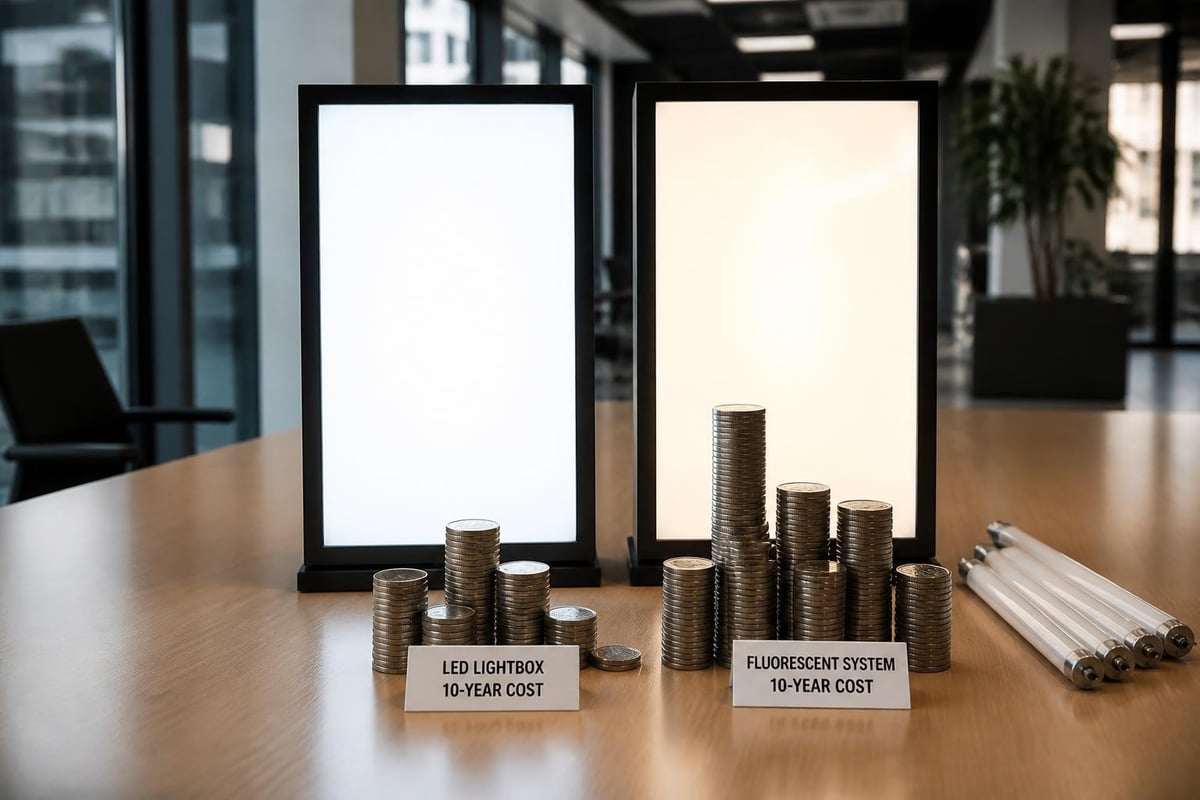
The financial case for modern lightbox signage extends beyond initial purchase costs to encompass operational expenses and lifecycle value. LED-illuminated units deliver compelling economic advantages that improve the return on investment for businesses committed to maintaining continuous brand visibility.
Power Consumption Analysis
Traditional fluorescent lightboxes consumed between 80-120 watts per square metre of display area, creating significant energy costs for businesses operating signage 12-24 hours daily. LED technology reduces consumption to 15-30 watts per square metre whilst delivering superior brightness and colour quality.
| Technology | Power Draw (per m²) | Annual Cost (12hr/day)* | Lamp Lifespan | Maintenance Frequency |
|---|---|---|---|---|
| Fluorescent T8 | 95W | £142 | 10,000 hours | Every 14 months |
| Fluorescent T5 | 72W | £108 | 20,000 hours | Every 28 months |
| LED (standard) | 24W | £36 | 50,000 hours | Every 7 years |
| LED (premium) | 28W | £42 | 100,000 hours | Every 14 years |
*Based on £0.34/kWh commercial electricity rate
Maintenance and Longevity
Reduced maintenance requirements represent a significant operational advantage of LED lightboxes. Whilst fluorescent systems demand regular tube replacement and ballast servicing, quality LED installations may operate for a decade or more before requiring component replacement. This reliability proves particularly valuable for difficult-to-access installations such as high-level suspended units or facade-mounted signage.
When evaluating lightbox options, businesses should consider the total cost of ownership rather than simply comparing purchase prices. A premium LED system with a 15-year operational life and minimal maintenance requirements often proves more economical than a budget fluorescent alternative requiring lamp replacement every 18 months and complete ballast refurbishment within five years.
Strategic Placement for Business Success
The effectiveness of lightboxes extends beyond their technical specifications to encompass strategic positioning that maximises customer engagement and supports broader marketing objectives. Understanding sightlines, decision points, and customer journey mapping enables businesses to extract maximum value from their illuminated signage investments.
Retail Environment Applications
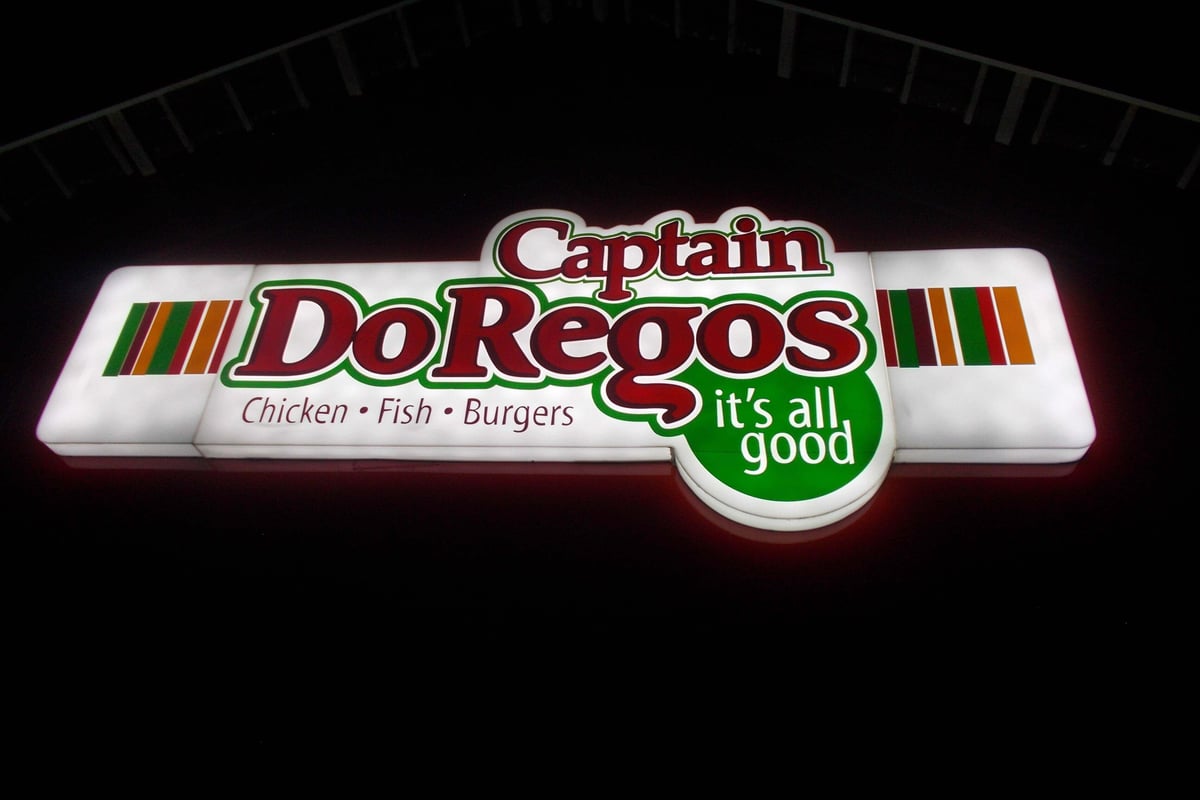
Retail businesses deploy lightboxes across multiple touchpoints throughout the customer journey. Exterior facade displays serve as primary attraction mechanisms, drawing attention from passing foot and vehicle traffic with illuminated brand marks and promotional messaging. These installations work particularly effectively during evening hours when competing visual stimuli diminish and the illuminated display commands enhanced attention.
Interior lightboxes guide customers through retail spaces, highlighting departments, promotional zones, and featured product categories. Research demonstrates that illuminated signage increases dwell time in specific retail areas by 23-35% compared to non-illuminated alternatives, directly correlating with improved conversion rates and transaction values. Many retailers combine lightboxes with other visual merchandising elements such as reception signs to create cohesive wayfinding systems that enhance the shopping experience.
Hospitality and Food Service Sectors
Restaurants, hotels, and entertainment venues leverage lightboxes to create atmosphere whilst communicating essential information. Menu boards represent one of the most common applications, with backlit displays ensuring legibility in varied lighting conditions whilst elevating perceived brand quality. The ability to update graphics allows seasonal menu changes or promotional periods without replacing entire signage systems.
Hotel corridor signage benefits from the consistent illumination lightboxes provide, ensuring wayfinding remains effective regardless of time or ambient lighting conditions. Conference facilities utilise modular lightbox systems that can be reconfigured to display different event information, sponsors, or directional guidance based on daily requirements.
Quality Standards and Safety Compliance
Professional lightbox installations must satisfy rigorous safety standards that protect both property and personnel. Understanding applicable regulations and certification requirements ensures businesses avoid compliance issues whilst selecting products engineered for reliable long-term operation.
Electrical Safety Requirements
Illuminated signage operates at mains voltage and must incorporate appropriate safeguards against electrical hazards. Quality manufacturers design lightboxes with proper insulation, earth bonding, and ingress protection suited to the installation environment. IP ratings (Ingress Protection) indicate resistance to dust and moisture penetration, with exterior installations typically requiring IP65 or higher certification.
Internal wiring must utilise appropriate conductor sizes and termination methods that prevent overheating and connection failure. Properly designed lightboxes incorporate thermal protection that disconnects power if operating temperatures exceed safe parameters, preventing fire risks from component failure or inadequate ventilation.
Structural and Wind Load Considerations
Exterior lightboxes face significant structural demands from wind pressure, particularly in exposed locations or at elevated mounting heights. Engineering calculations must account for the display's effective sail area and local wind speed data to specify appropriate fixing systems and structural reinforcement. Large-format installations may require sealed engineer certifications before building control approval.
The physical weight of lightboxes also demands consideration, particularly for older buildings where wall construction may not provide adequate fixing strength for modern signage systems. Structural surveys identify suitable fixing locations and may recommend reinforcement measures to ensure safe long-term installation.
Specialist Applications Beyond Commercial Signage
Whilst retail and commercial installations represent the primary market for lightboxes, these versatile display systems serve numerous specialist applications where consistent, high-quality illumination proves essential. Understanding these broader use cases demonstrates the adaptability of lightbox technology across diverse professional contexts.
Photographic and Imaging Applications
Professional photographers and imaging specialists rely on lightboxes to provide consistent, colour-accurate illumination for critical viewing tasks. Transparency viewing lightboxes enable accurate assessment of film-based photographs and artwork, whilst digitisation workflows for museum specimens depend on carefully calibrated lightbox systems to ensure even illumination and accurate colour capture.
The DiSSCo digitisation guidance provides detailed specifications for imaging stations incorporating lightboxes, demonstrating the importance of proper illumination in creating archival-quality digital records. These applications demand exceptionally uniform light distribution and precise colour temperature control that exceed typical commercial signage requirements.
Medical and Diagnostic Uses
Healthcare facilities utilise specialised lightboxes for viewing radiographic images, though digital systems increasingly replace traditional film-based workflows. Modern medical lightboxes maintain strict brightness standards and colour temperature specifications to ensure diagnostic accuracy, demonstrating how specialised applications drive technological refinement that eventually benefits commercial signage markets.
Choosing the Right Lightbox for Your Business
Selecting appropriate lightbox signage requires balancing multiple factors including budget constraints, aesthetic preferences, technical requirements, and long-term operational considerations. A systematic evaluation process ensures businesses invest in solutions that deliver sustained value whilst supporting brand objectives.
Assessment Criteria
Begin by defining your specific requirements across these dimensions:
- Installation environment: Interior or exterior, ambient lighting conditions, exposure to weather
- Viewing parameters: Typical viewing distance, approach angles, competing visual elements
- Graphic flexibility: Static installation versus regular content updates, seasonal campaigns
- Budget allocation: Initial capital investment versus lifecycle costs, maintenance capabilities
- Brand alignment: Visual style, quality perception, integration with existing signage portfolio
For businesses seeking professional illuminated signage solutions, Lightbox Signage from Signshoponline provides expertly manufactured units available in both Mae-West and Acrylic Return configurations. These purpose-built displays deliver the durability and visual impact that demanding commercial applications require.
Working with Professional Suppliers
Professional signage suppliers bring valuable expertise to the specification and installation process, helping businesses navigate technical complexities whilst avoiding common pitfalls. Quality suppliers provide comprehensive services including site surveys, structural assessments, graphic design consultation, professional installation, and ongoing maintenance support.
When evaluating potential suppliers, consider their portfolio of completed installations, understanding of local building codes and electrical regulations, warranty provisions, and ability to provide ongoing support. References from businesses operating similar installations offer insights into real-world performance and supplier reliability beyond marketing claims.
Emerging Trends and Future Developments
The lightbox industry continues evolving as new technologies emerge and customer expectations shift. Staying informed about developing trends enables businesses to make future-proof investments that remain relevant and effective throughout extended operational lifespans.
Digital Integration and Dynamic Content
Static lightboxes increasingly compete with digital signage solutions offering video content and real-time information updates. However, traditional lightboxes maintain advantages in total cost of ownership, simplicity of operation, and visual impact in specific applications. Some manufacturers now offer hybrid solutions combining printed graphics with integrated digital screens, merging the benefits of both technologies.
Smart lighting controls represent another significant trend, with lightboxes incorporating sensors that adjust brightness based on ambient conditions, occupancy detection, or time-based schedules. These systems optimise energy consumption whilst ensuring displays maintain appropriate visibility throughout changing daily conditions.
Sustainable Materials and Circular Economy
Environmental considerations increasingly influence lightbox specification, with businesses seeking sustainable alternatives to traditional materials and manufacturing processes. Recyclable aluminium extrusions, LED technology free from hazardous substances, and graphic substrates incorporating recycled content respond to this demand whilst maintaining performance standards.
Forward-thinking manufacturers design lightboxes for disassembly and component reuse, enabling businesses to update graphic faces and LED modules without discarding entire units. This circular economy approach reduces both environmental impact and lifecycle costs, aligning business operations with broader sustainability objectives. Similar thinking influences other promotional products such as pull-up banners and portable display systems where reusability drives value.
Technical Specifications and Performance Metrics
Understanding key performance metrics enables informed comparison between different lightbox options and ensures selected solutions meet specific application requirements. Professional specifications define these parameters precisely, creating objective standards for evaluating competing proposals.
Illumination Uniformity
Light uniformity measures how evenly illumination distributes across the display surface, typically expressed as a ratio between the brightest and dimmest areas. Quality lightboxes achieve uniformity ratios of 80% or better, ensuring graphics appear consistent without visible hot spots or dark zones. Edge-lit systems may struggle with uniformity in larger formats, whilst back-lit arrays more easily maintain consistent illumination across expansive displays.
Testing protocols measure illumination levels at defined grid points across the display surface, with results compiled into uniformity maps that visualise distribution patterns. These measurements should occur both during initial commissioning and at regular intervals throughout operational life to detect degradation requiring maintenance intervention.
Colour Temperature and Rendering
Colour temperature, measured in Kelvin (K), defines the apparent warmth or coolness of the light source. Most commercial lightboxes operate between 4,000K and 6,500K, with specific selection depending on brand identity and desired psychological impact. Warmer temperatures (4,000K-5,000K) create inviting, comfortable atmospheres suited to hospitality and retail environments, whilst cooler temperatures (5,500K-6,500K) convey professionalism and precision appropriate for corporate and medical contexts.
Colour Rendering Index (CRI) quantifies how accurately the light source reproduces colours compared to natural daylight. Quality LED systems achieve CRI values above 80, with premium units reaching 90+ for applications where colour accuracy proves critical. High CRI values ensure graphics appear as intended, maintaining brand colour integrity and visual impact.
Lightboxes remain indispensable tools for businesses seeking reliable, high-impact visual communication that performs consistently around the clock. Their evolution from simple fluorescent boxes to sophisticated LED-illuminated displays reflects broader technological advancement whilst maintaining the fundamental benefits that have made them signage mainstays for decades. Whether you're establishing new retail presence, refreshing existing brand touchpoints, or seeking versatile promotional displays, Signshoponline delivers professional lightbox solutions alongside comprehensive signage expertise to elevate your business visibility and support your marketing objectives.


