


Outdoor office signage serves as the critical first touchpoint between your organisation and the outside world, functioning simultaneously as a navigational tool, brand statement, and architectural element. Whether you're establishing a corporate headquarters, professional services practice, or multi-tenant office park, the quality and execution of your office signage outdoor directly influences visitor confidence, wayfinding efficiency, and perceived professionalism. In 2026, outdoor signage has evolved beyond simple identification to encompass sustainability considerations, digital integration, and increasingly sophisticated materials that withstand environmental challenges whilst maintaining visual impact.
Understanding Office Signage Outdoor Categories
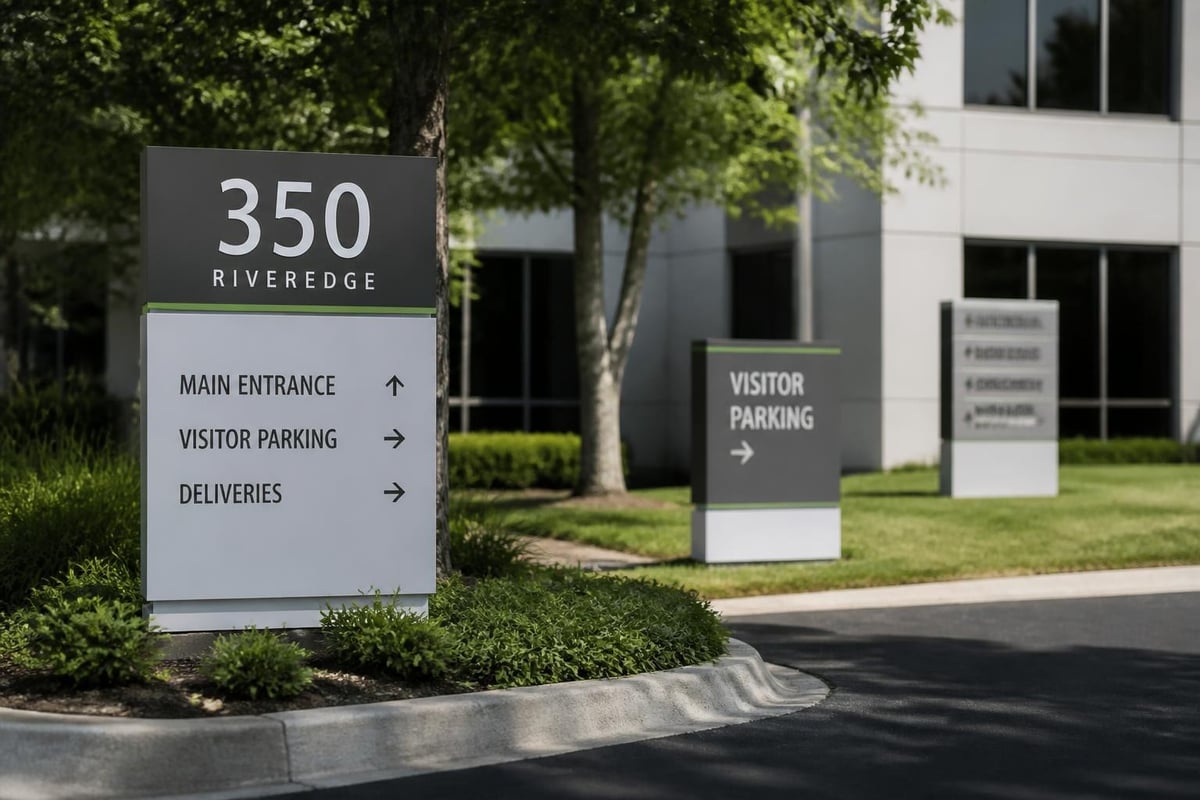
Office signage outdoor encompasses several distinct categories, each serving specific functional and aesthetic purposes. Monument signs anchor a property's entrance with ground-level presence, typically constructed from materials such as stone, metal, or high-density foam with architectural finishes. These installations project permanence and stability whilst accommodating illumination systems and multiple tenant listings.
Directory and wayfinding signage guides visitors through complex office campuses or business parks, reducing confusion and improving the arrival experience. These systems often integrate with directional signs that work cohesively to create intuitive navigation paths from car park to entrance.
Primary Identification Elements
Building-mounted signage represents the most visible category of office signage outdoor, positioned on facades, rooflines, or purpose-built structures attached to the building envelope. Channel letters, particularly illuminated versions, deliver exceptional visibility during evening hours whilst maintaining professional aesthetics. The fabricated 3D signage approach creates dimensional depth that enhances readability and brand impact across extended viewing distances.
| Sign Type | Typical Application | Visibility Range | Illumination Options |
|---|---|---|---|
| Monument | Property entrance | 50-200 metres | LED, spotlight, halo |
| Channel letters | Building facade | 100-300 metres | Internal LED, neon |
| Post & panel | Directional | 20-50 metres | Optional reflective |
| Pylon | Highway visibility | 300-1000 metres | Cabinet lighting |
Pylon signage extends visibility for properties located along high-traffic corridors or set back from roadways. These tall structures require careful engineering consideration, particularly regarding wind loads, foundation requirements, and local zoning restrictions.
Material Selection for Durability and Performance
The choice of materials fundamentally determines the longevity, maintenance requirements, and aesthetic quality of office signage outdoor installations. Aluminium remains the industry standard for dimensional letters and cabinet structures, offering excellent corrosion resistance, formability, and weight-to-strength ratios. Marine-grade aluminium specifications prove particularly valuable in coastal environments where salt spray accelerates oxidation.
Acrylic faces provide superior light transmission for illuminated applications whilst resisting UV degradation and colour shift over extended service lives. High-impact polycarbonate offers enhanced durability in areas subject to potential impact or extreme weather conditions, though at somewhat reduced optical clarity compared to acrylic alternatives.
Weather-Resistant Construction Methods
Stainless steel fasteners, through-welded seams, and silicone weather seals prevent moisture intrusion that leads to internal corrosion and illumination failure. Powder-coated finishes deliver superior adhesion and environmental resistance compared to traditional wet paint systems, maintaining colour fidelity through years of UV exposure.
- Anodised aluminium resists scratching and maintains metallic lustre
- HDU (high-density urethane) enables intricate dimensional routing whilst remaining lightweight
- Marine-grade stainless steel provides maximum corrosion resistance for coastal installations
- PVC substrates offer budget-friendly solutions for temporary or short-term applications
- Composite materials combine multiple substrates for optimised performance characteristics
The U.S. Green Building Council provides comprehensive guidance on sustainable material selection, emphasising recyclability, low-VOC finishes, and life-cycle environmental impact considerations increasingly relevant to corporate sustainability initiatives.
Regulatory Compliance and Permitting Requirements
Office signage outdoor projects must navigate complex regulatory frameworks encompassing building codes, zoning ordinances, electrical standards, and accessibility requirements. The ADA Standards for Accessible Design mandate specific technical parameters for exterior signage elements, particularly regarding mounting heights, character proportions, contrast ratios, and tactile features where applicable.
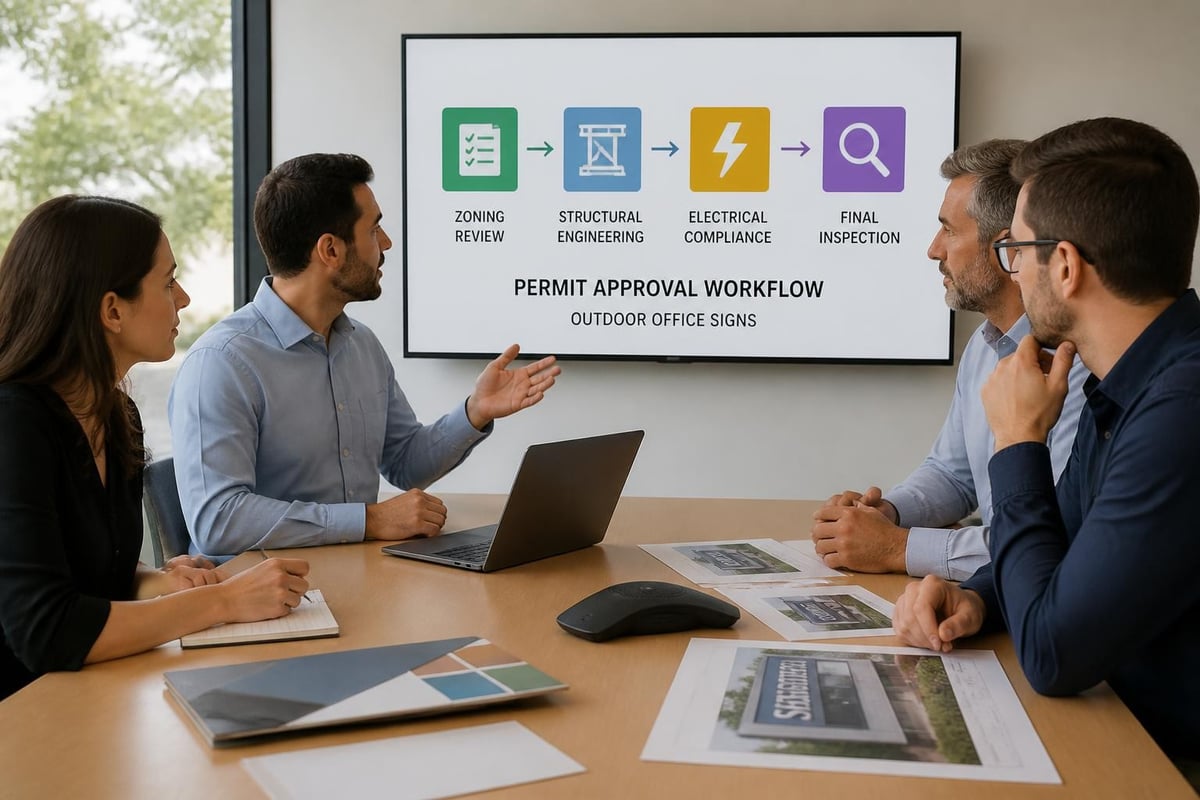
Municipal sign codes typically regulate dimensional limitations, setback requirements, illumination intensity, and structural attachment methods. The City of San Diego's sign permit guide exemplifies the detailed submittal requirements, engineering documentation, and approval workflows that characterise most jurisdictions' permitting processes.
Structural and Electrical Specifications
Engineering calculations must account for wind loads, seismic considerations, and structural attachment capacity according to International Building Code provisions. The IBC Appendix H requirements establish minimum design parameters for sign thickness, bracing, and anchoring methods based on exposure categories and geographic location.
Illuminated office signage outdoor requires electrical permits, licensed contractor installation, and compliance with National Electrical Code standards for outdoor rated components, GFCI protection, and photocell or timer controls. Energy efficiency considerations increasingly influence specification decisions, with LED technology delivering operational cost reductions exceeding 75% compared to legacy fluorescent or neon systems.
- Research applicable zoning district sign regulations
- Prepare dimensional drawings showing placement and setbacks
- Develop structural calculations stamped by licensed engineer
- Submit electrical plans showing circuit routing and protection
- Coordinate building department reviews across multiple disciplines
- Obtain separate electrical, building, and sign-specific permits
- Schedule required inspections at rough-in and final stages
Design Principles for Maximum Impact
Effective office signage outdoor balances visibility, legibility, and brand alignment through strategic application of typography, colour theory, and spatial composition. Letter height calculations must account for viewing distance, reading speed, and environmental context; the general formula suggests 25mm of letter height for every metre of intended viewing distance, though this baseline requires adjustment for typeface weight, contrast, and ambient lighting conditions.
Sans-serif typefaces generally deliver superior legibility at distance compared to serif alternatives, with medium to bold weights providing optimal stroke definition. Condensed letterforms allow larger point sizes within constrained dimensional limits, though excessive compression compromises readability.
Colour and Contrast Strategies
High-contrast combinations maximise visibility across varying lighting conditions and viewing angles. Dark letters on light backgrounds or illuminated letters against dark building facades create the crisp edge definition essential for rapid recognition. Metallics, particularly brushed or polished stainless steel, convey premium positioning whilst maintaining excellent daytime legibility through reflective properties.
Brand colour palette integration requires careful consideration of material availability, fade resistance, and illumination compatibility. Custom colour matching through powder coating or vinyl film application enables precise brand alignment, though maintenance of obscure colours may prove challenging over extended service lives.
| Design Element | Best Practice | Impact on Visibility |
|---|---|---|
| Letter height | 75-200mm for building ID | Determines maximum viewing range |
| Stroke weight | Medium to bold | Improves edge definition |
| Colour contrast | 70% minimum difference | Enhances legibility |
| Spacing | 1/5 letter height | Prevents visual crowding |
| Background | Non-reflective preferred | Reduces glare interference |
The Society for Experiential Graphic Design offers extensive case studies demonstrating how thoughtful wayfinding systems integrate office signage outdoor elements into cohesive environmental graphic programmes that enhance user experience whilst reinforcing brand narratives.
Illumination Technology and Strategies
Illuminated office signage outdoor extends visibility beyond daylight hours, maintaining brand presence and wayfinding functionality throughout evening periods. LED technology dominates contemporary installations through exceptional energy efficiency, extended service life (50,000+ hours), reduced maintenance requirements, and superior colour consistency compared to legacy lighting systems.
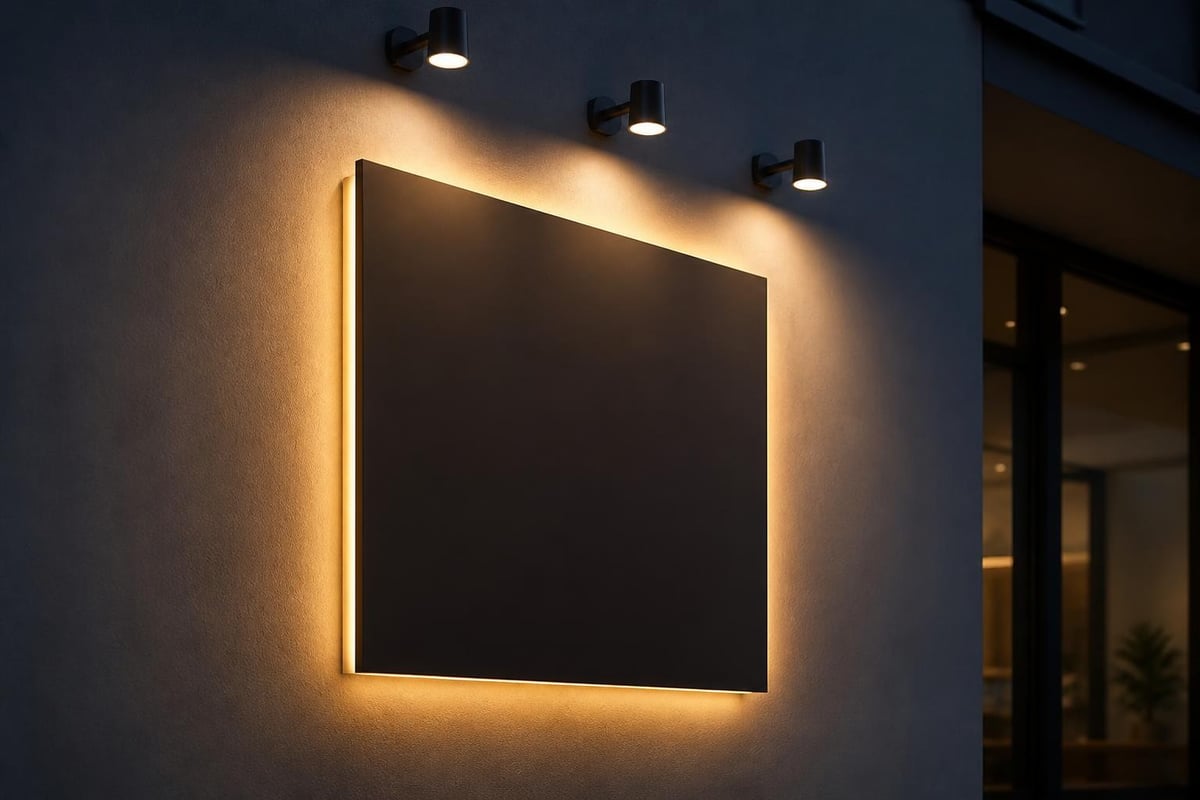
Front-illuminated applications employ external fixtures-typically LED spotlights or floodlights-directed at sign faces from concealed positions. This approach suits non-translucent materials such as metal, wood, or dimensional letters mounted against opaque backgrounds. Proper aiming prevents light spill onto adjacent properties whilst delivering uniform coverage across sign surfaces.
Internal Illumination Methods
Channel letters with internal LED modules create dramatic halo effects when mounted with standoffs, projecting letter shapes as backlit silhouettes against building facades. This technique, particularly effective for contemporary architectural styles, generates sophisticated visual impact with relatively modest power consumption. Lightbox signage provides another illumination approach, containing light sources within cabinet structures faced with translucent materials that distribute illumination evenly across larger surface areas.
For organisations committed to sustainable operations, the reduced energy consumption of LED-illuminated office signage outdoor aligns with broader environmental objectives. Combined with photocell or astronomical timer controls that automatically adjust to ambient light levels, these systems minimise unnecessary operation whilst ensuring visibility when required.
- LED modules deliver 100+ lumens per watt efficiency
- RGB LED systems enable colour-changing capabilities for special events
- Edge-lit acrylic panels create uniform illumination with minimal depth
- Solar-powered options eliminate electrical infrastructure costs in remote locations
- Smart controls integrate with building management systems for centralised operation
Installation Considerations and Methods
Professional installation ensures structural integrity, weatherproof performance, and aesthetic precision that DIY approaches rarely achieve. Mounting substrate evaluation must precede any installation planning; concrete, masonry, steel, and various cladding materials each require specific fastener types, expansion considerations, and penetration sealing methods.
Through-bolt mounting into structural elements provides maximum security for heavy dimensional letters or cabinet signs, though installers must verify attachment point load capacity and coordinate penetrations with building weatherproofing systems. Chemical anchors offer retrofit solutions where through-bolting proves impractical, developing mechanical interlock within drilled holes through adhesive expansion.
Specialised Mounting Systems
Stud-mount systems create standoff depth that enhances dimensional appearance whilst facilitating halo illumination effects. These installations require precision drilling to maintain alignment across multiple fastener points, with templates ensuring accurate hole placement regardless of substrate irregularities.
Monument signs demand substantial foundation work, typically specifying reinforced concrete footings extending below frost depth in temperate climates. The MUTCD wayfinding guidance addresses placement considerations for signs near roadways, ensuring adequate sight distances and setbacks from traffic lanes.
Post-installation weatherproofing proves critical for longevity; silicone sealants around penetrations, flashing at upper edges, and weep holes at lower positions prevent moisture accumulation that leads to interior corrosion and finish deterioration. Quality installations include regular maintenance provisions, with access panels enabling lamp replacement, electrical servicing, and periodic cleaning without complete sign removal.
Maintenance and Lifecycle Management
Proactive maintenance programmes preserve the professional appearance and functional performance of office signage outdoor installations across multi-year service lives. Quarterly cleaning schedules remove accumulated dirt, pollen, and environmental deposits that diminish visibility and potentially harbour corrosive compounds. Non-abrasive cleaners formulated for specific substrate materials prevent finish damage whilst achieving effective soil removal.
Annual electrical inspections verify continued operation of illumination systems, identifying component failures before they compromise entire letter or cabinet sections. LED modules, whilst exceptionally long-lived, eventually require replacement; modular designs facilitate selective servicing rather than complete retrofit.
Preventive Maintenance Protocols
- Inspect mounting fasteners for looseness caused by thermal cycling
- Verify seal integrity around electrical penetrations and component junctions
- Test emergency shutoff systems and GFCI protection functionality
- Document finish condition with dated photographs for degradation tracking
- Clean lenses and faces using manufacturer-approved products and methods
- Trim vegetation encroaching on viewing corridors or sign illumination
- Update tenant directories promptly to maintain accuracy and professionalism
Finish restoration extends service life when environmental exposure degrades painted or powder-coated surfaces. Localised touch-up addresses minor scratches or chips, whilst complete refinishing restores appearance when widespread deterioration occurs. Proactive intervention at early degradation stages prevents substrate corrosion that ultimately necessitates complete replacement.
Contemporary office signage outdoor increasingly incorporates modular design principles that facilitate component-level replacement rather than complete system obsolescence. This approach aligns with sustainability objectives whilst reducing lifecycle costs through selective renewal of degraded elements.
Integration with Digital and Smart Building Systems
Modern office environments increasingly integrate traditional office signage outdoor with digital components that deliver dynamic content capability alongside static identification. Digital displays within monument structures or incorporated into building facades enable message variation for events, tenant updates, or emergency notifications whilst maintaining the permanent branding elements essential for consistent identification.
Networked control systems allow centralised management across multi-building campuses, coordinating illumination schedules, content updates, and system diagnostics from single administrative interfaces. These platforms often integrate with broader building management systems, enabling energy optimisation through occupancy-responsive lighting and automated fault reporting.
Hybrid approaches combining dimensional letters for primary identification with supplemental digital panels for variable messaging deliver flexibility without compromising the architectural permanence and weather resistance inherent to traditional fabricated signage. This strategy proves particularly effective for corporate campuses hosting diverse events or multi-tenant properties with frequent occupancy changes.
The signage industry continues evolving toward sustainable, intelligent systems that balance visual impact with operational efficiency. As organisations prioritise environmental responsibility and digital transformation, office signage outdoor specifications increasingly reflect these broader institutional values through material selection, energy management, and technological integration.
Successful office signage outdoor projects require careful coordination of design principles, material science, regulatory compliance, and installation expertise to achieve lasting performance and professional impact. Whether you're developing a new corporate campus, refreshing existing identification, or implementing comprehensive wayfinding systems, partnering with experienced professionals ensures optimal results. Signshoponline brings extensive signage expertise across monument installations, dimensional letters, digital integration, and complete exterior identification systems, delivering custom solutions tailored to your specific requirements and site conditions.


