


Modern businesses face unprecedented pressure to capture attention, communicate effectively, and deliver memorable experiences across every customer touchpoint. Solution digital signage represents a comprehensive approach to visual communication that extends far beyond simple screens displaying rotating messages. By integrating hardware, software, content strategy, and analytics into a unified ecosystem, organisations can transform static environments into dynamic, responsive spaces that adapt to audience behaviour, business priorities, and real-time conditions.
Understanding the Solution Digital Signage Ecosystem
Solution digital signage encompasses the complete infrastructure required to plan, deploy, manage, and optimise digital displays across single or multiple locations. Unlike standalone screens, a true solution integrates several critical components into a cohesive system.
Core Architecture Components
Every effective solution digital signage deployment relies on four foundational elements working in harmony:
- Display hardware: Commercial-grade screens, video walls, interactive kiosks, or projection systems selected for environmental conditions and viewing requirements
- Media players: Dedicated devices running content delivery software, ranging from enterprise-grade appliances to system-on-chip displays
- Content management systems (CMS): Cloud-based or on-premises platforms enabling centralised scheduling, playlist management, and content distribution
- Network infrastructure: Reliable connectivity supporting content updates, remote monitoring, and real-time data integration
The AVIXA guidance on digital signage players provides technical considerations for selecting appropriate hardware architectures based on content complexity, resolution requirements, and deployment scale.
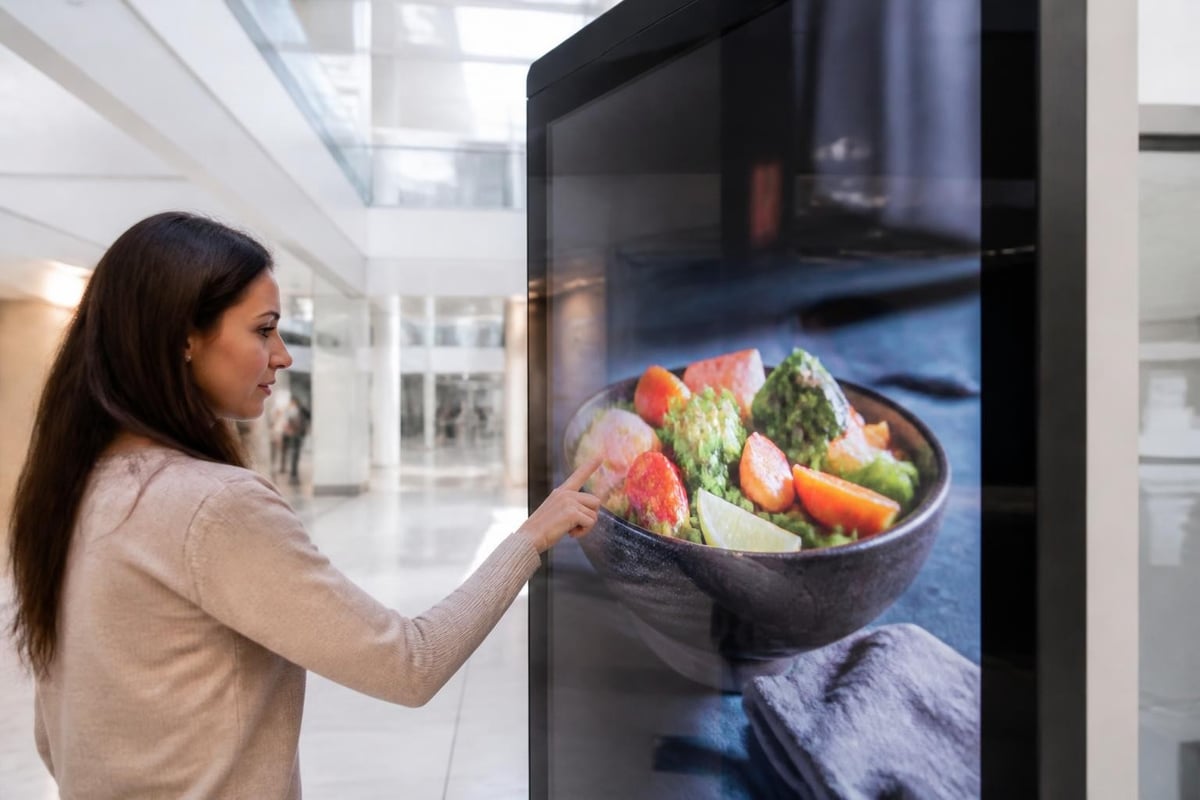
Integration Capabilities
Modern solution digital signage extends beyond traditional one-way communication through sophisticated integration points:
| Integration Type | Function | Business Value |
|---|---|---|
| Point-of-sale systems | Display real-time inventory, pricing, promotions | Reduced discrepancies, dynamic pricing |
| Occupancy sensors | Adjust content based on foot traffic patterns | Improved relevance, energy efficiency |
| Social media feeds | Surface user-generated content, trending topics | Enhanced engagement, social proof |
| Weather services | Contextualise messaging to current conditions | Increased conversion, practical utility |
| CRM platforms | Personalise content for identified customers | Targeted messaging, loyalty reinforcement |
These connections transform digital signage from a broadcast medium into a responsive communication channel that reacts intelligently to context.
Strategic Planning for Solution Digital Signage Deployments
Successful implementations begin with clear objectives and thorough environmental analysis rather than technology selection. The planning phase determines whether your investment delivers measurable returns or becomes underutilised infrastructure.
Audience Analysis and Placement Strategy
Effective solution digital signage starts with understanding viewer behaviour, dwell time, and decision-making moments. Research from the OAAA measurement standards demonstrates that placement, viewing distance, and ambient conditions significantly impact message retention and response rates.
Consider these placement principles:
- Decision zones: Position displays where customers make purchasing choices or require wayfinding assistance
- Dwell areas: Utilise waiting areas, queues, and lounges for longer-form content and detailed information
- Transition spaces: Deploy high-impact messaging in corridors, entrances, and circulation areas with brief exposure windows
- Interactive touchpoints: Install touch-enabled displays where self-service, exploration, or configuration enhance the customer journey
Viewing distance calculations determine appropriate screen sizes and resolution requirements. A general formula allocates one inch of diagonal screen size per foot of viewing distance, adjusted for ambient light and content density.
Content Strategy Development
Solution digital signage succeeds or fails based on content quality, relevance, and refresh frequency. Static, outdated, or generic messaging quickly becomes visual wallpaper that audiences unconsciously ignore.
Develop content frameworks addressing:
- Information hierarchy: Prioritise essential messages, legal requirements, and time-sensitive announcements
- Brand consistency: Maintain visual identity across all touchpoints whilst adapting layouts for different screen formats
- Update cycles: Establish refresh schedules balancing production costs against audience expectations for novelty
- Compliance requirements: Ensure accessibility, privacy regulations, and industry-specific disclosure standards
The Digital Signage Today accessibility guidance emphasises universal design principles that improve readability and comprehension for all viewers, not just those with specific accessibility needs.

Technical Considerations for Robust Deployments
Enterprise-grade solution digital signage demands careful attention to reliability, security, and maintainability. Systems deployed in customer-facing environments cannot afford frequent downtime or technical glitches that undermine professional credibility.
Hardware Selection Criteria
Commercial displays differ substantially from consumer televisions despite superficial similarities. Professional-grade screens feature:
- Extended operational ratings supporting 16-24 hour daily usage over multi-year lifecycles
- Enhanced brightness specifications (450-700 nits) ensuring visibility under ambient lighting conditions
- Portrait orientation support and flexible mounting options for diverse installation requirements
- Integrated media players and content management capabilities reducing external component dependencies
- Warranty coverage and service-level agreements appropriate for business-critical deployments
When evaluating lightbox signage alongside digital displays, consider lifecycle costs including energy consumption, maintenance requirements, and content update workflows. Digital solutions offer unmatched flexibility for organisations with frequently changing messaging needs.

Security and Network Architecture
Connected digital signage introduces cybersecurity considerations often overlooked during initial deployments. The NIST guidance on IoT device security provides comprehensive frameworks for securing networked displays and associated infrastructure.
Essential security measures include:
- Network segmentation: Isolate digital signage traffic from critical business systems using VLANs or separate physical networks
- Device authentication: Implement certificate-based authentication preventing unauthorised content injection or system access
- Encrypted communications: Require TLS/SSL for all content transfers and management connections
- Regular firmware updates: Establish processes for applying security patches across distributed display networks
- Access controls: Limit content publishing and system administration privileges following least-privilege principles
Multi-location deployments benefit from centralised management platforms providing visibility into device health, content compliance, and security status across the entire estate.
Programmatic and Dynamic Content Capabilities
Advanced solution digital signage leverages automation, data integration, and audience analytics to deliver contextually relevant messaging at scale. These capabilities distinguish modern systems from traditional scheduled playlists.
Real-Time Content Adaptation
Dynamic content engines adjust messaging based on multiple input signals:
- Time and date triggers: Automatically switch content for breakfast, lunch, and dinner periods in hospitality environments
- Inventory levels: Promote available products whilst suppressing out-of-stock items in retail settings
- Weather conditions: Adjust product recommendations based on temperature, precipitation, and seasonal factors
- Audience demographics: Utilise camera-based analytics to tailor messaging for detected age ranges and gender compositions
- Business metrics: Display performance dashboards, safety statistics, or operational KPIs in corporate environments
The IAB Tech Lab standards for programmatic creative enable secure delivery of interactive, data-driven content to digital signage networks using established advertising technology protocols.
Analytics and Performance Measurement
Comprehensive solution digital signage platforms capture detailed engagement metrics supporting continuous optimisation:
| Metric Category | Measurements | Application |
|---|---|---|
| Attention | Dwell time, view duration, gaze tracking | Content effectiveness, placement validation |
| Interaction | Touchscreen engagement, QR code scans, gesture recognition | Call-to-action performance, user interest |
| Conversion | Product lookups, coupon redemptions, sales attribution | ROI calculation, campaign effectiveness |
| Technical | Playback errors, network latency, uptime percentage | System reliability, maintenance planning |
Research published in Frontiers in Computer Science examines user acceptance factors and interaction patterns with advanced digital signage, providing evidence-based insights for experience design decisions.
Industry-Specific Applications
Solution digital signage adapts to diverse sector requirements, with implementations varying substantially across industries based on regulatory environments, audience expectations, and operational priorities.
Retail and Hospitality Environments
Customer-facing businesses utilise solution digital signage for promotional messaging, wayfinding, queue management, and experiential marketing. Menu boards represent a specialised application where digital displays streamline updates across multiple locations whilst enabling dynamic pricing and visual merchandising strategies.
Quick-service restaurants report significant benefits:
- Reduced perceived wait times through entertaining or informative queue-line content
- Increased average transaction values via targeted upsell suggestions
- Operational efficiency through instant menu updates eliminating manual board changes
- Enhanced customer satisfaction scores linked to improved information clarity
The OAAA guide to moving and dynamic media explores emerging formats and programmatic opportunities relevant to retail digital signage strategies.
Corporate and Educational Settings
Internal communications applications emphasise employee engagement, safety messaging, space utilisation, and cultural reinforcement. Solution digital signage in these environments often integrates with:
- Room booking systems displaying meeting schedules and availability
- Emergency notification platforms for rapid crisis communication
- Corporate social networks surfacing employee achievements and company news
- Learning management systems promoting training opportunities and compliance reminders
Educational institutions deploy digital signage for wayfinding, event promotion, emergency alerts, and showcasing student work, with accessibility considerations particularly critical in public educational settings.
Transportation and Public Spaces
Wayfinding, schedule information, and public safety messaging drive digital signage deployments in transportation hubs, government facilities, and civic spaces. These applications demand exceptional reliability, accessibility compliance, and integration with multiple data sources.
High-availability requirements typically necessitate:
- Redundant network connections preventing single points of failure
- Uninterruptible power supplies maintaining operation during brief outages
- Automated failover to backup content when live data feeds become unavailable
- Regular content audits ensuring accuracy and regulatory compliance
The W3C accessibility guidance addresses how web accessibility standards apply to information and communication technology including digital signage systems in public environments.
Content Production and Management Workflows
Sustainable solution digital signage programmes establish efficient processes for content creation, approval, distribution, and archiving that balance creative quality against operational scalability.
Production Considerations
Professional content optimised for digital signage differs from print, web, or broadcast media in several important aspects:
- Viewing duration: Design for 3-7 second exposure windows in high-traffic areas, 15-30 seconds in dwell zones
- Legibility requirements: Utilise high-contrast colour schemes, generous whitespace, and font sizes appropriate for viewing distances
- Motion and animation: Apply subtle movement attracting attention without causing viewer fatigue or distraction
- Audio strategy: Consider whether sound enhances or detracts from the environment, with fallback visual-only versions
Template systems accelerate production whilst maintaining brand consistency across diverse content types and screen formats.
Governance and Compliance
Multi-stakeholder organisations require clearly defined workflows managing content approval, version control, and regulatory compliance. Effective governance frameworks specify:
- Approval authorities: Who authorises different content categories and deployment scopes
- Review cycles: Mandatory intervals for content updates ensuring accuracy and relevance
- Brand standards: Design specifications, messaging guidelines, and quality benchmarks
- Legal requirements: Disclaimer language, accessibility standards, and industry-specific regulations
Cloud-based CMS platforms provide audit trails documenting content history, approval chains, and modification records supporting compliance verification and quality assurance.
Return on Investment and Business Justification
Solution digital signage represents a significant capital investment requiring careful financial analysis and ongoing performance measurement to justify expenditure and guide optimisation efforts.
Cost Structure Analysis
Total cost of ownership encompasses initial deployment expenses and recurring operational costs:
Initial investment:
- Display hardware, mounting systems, and installation labour
- Media players, network equipment, and infrastructure upgrades
- Content management platform licences and integration services
- Initial content production and staff training
Ongoing expenses:
- Software subscription or maintenance fees
- Content production and refresh costs
- Electricity consumption and environmental control
- Technical support, repairs, and eventual hardware replacement
Accurate TCO calculations prevent budget surprises and enable meaningful comparison with alternative communication channels like print signage, fabric banners, or traditional advertising.
Value Realisation Metrics
Organisations measure solution digital signage success through both quantitative and qualitative indicators:
| Value Category | Measurement Approach | Example Metrics |
|---|---|---|
| Revenue impact | Sales attribution, basket analysis | Average transaction value increase, promotional redemption rates |
| Operational efficiency | Process timing, resource utilisation | Queue management improvement, staff enquiry reduction |
| Communication effectiveness | Recall studies, comprehension testing | Message awareness scores, policy compliance rates |
| Customer experience | Satisfaction surveys, NPS correlation | Experience ratings, repeat visit frequency |
The AVNetwork coverage of engagement trends highlights emerging measurement techniques and analytics capabilities shaping ROI assessment in 2026.
Scalability and Future-Proofing
Solution digital signage investments should accommodate growth and technological evolution without requiring complete system replacement. Scalable architectures support:
- Incremental display additions across new locations or departments
- Software upgrades introducing enhanced capabilities to existing hardware
- Integration with emerging technologies like augmented reality or IoT sensors
- Migration paths from on-premises to cloud-based management platforms
Vendor selection criteria should emphasise open standards, documented APIs, and demonstrated commitment to long-term platform development rather than proprietary lock-in approaches.
Solution digital signage transforms how organisations communicate with customers, employees, and visitors by delivering dynamic, contextually relevant messaging through integrated technology ecosystems. From retail environments to corporate campuses, these comprehensive systems drive measurable improvements in engagement, operational efficiency, and revenue performance when deployed strategically with attention to content quality, technical robustness, and continuous optimisation. Whether you're implementing your first display or expanding an enterprise network, Signshoponline provides the expertise, products, and support needed to create impactful digital signage solutions tailored to your specific communication objectives and environmental requirements.


